
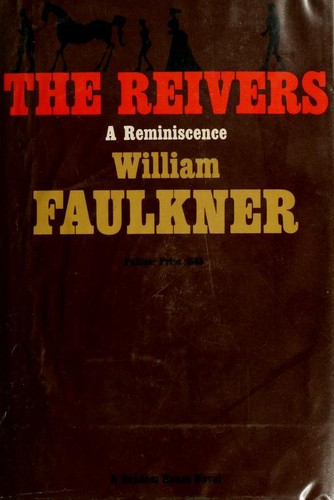
The Reivers
William Faulkner · 1897–1962 · USA
Why it matters
An eleven-year-old boy is dragged along on a stolen-car joyride from Mississippi to Memphis by two disreputable friends, and comes home changed by brothels, horse races, and hard-won mercy. Faulkner's last, warmest novel won him a second, posthumous Pulitzer.
At a glance
Faulkner's most linear, plainly comic novel, told in warm retrospective narration.
Deep dive
An eleven-year-old is dragged into a stolen-car joyride to a Memphis brothel, and Faulkner spends his last novel arguing that growing up means learning what to forgive.
Written for readers who have finished the book. No plot recap, and nothing here is safe to read first.
Themes & symbolism
Faulkner frames the whole escapade — Lucius Priest's grandfather's car 'borrowed' by Boon Hogganbeck for a joyride to Memphis, with young Lucius smuggled along and the family's Black companion Ned McCaslin engineering an elaborate horse-race swindle to get the car back — as retrospective narration, an old man remembering the week that actually made him an adult, and the novel's warmth comes from how completely Faulkner refuses to punish Lucius for what he witnesses: brothels, corruption, violence, and a stolen horse race are all rendered as an education rather than a fall, the exact inverse of the doom that structures most of his Yoknapatawpha fiction.
Ned McCaslin's horse-racing scheme — trading the stolen car for a racehorse he's certain, on almost mystical faith, can be trained to win, then rigging the actual race through means he won't fully explain — makes Ned, technically a servant in the Priest household, the story's real engineer of events, and Faulkner lets his competence and cunning run circles around every white character in the book without ever making that irony didactic; it's simply how the plot resolves, Ned proven right about the horse and about nearly everything else.
Miss Corrie, the Memphis prostitute Boon loves and eventually marries, and the brothel itself, presented without the moral horror such a setting would carry elsewhere in Faulkner, mark the novel's larger argument about mercy: Lucius's grandfather, learning everything that happened on the trip, chooses forgiveness and discretion over punishment, teaching Lucius — and the novel insists this is the actual lesson of becoming an adult — that a gentleman's job isn't avoiding wrongdoing entirely but knowing how to behave, and whom to protect, after you've already done it.
Faulkner's Last Word, and His Warmest
Published in 1962, months before Faulkner's death, and awarded a second, posthumous Pulitzer Prize, The Reivers is by far his most linear, plainly comic novel, trading the dense, doom-laden modernism of The Sound and the Fury or Absalom, Absalom! for a picaresque, retrospectively narrated tall tale closer in spirit to Mark Twain than to his own earlier reputation. Critics have debated ever since whether the shift represents late mastery — a writer finally allowing his fictional county some grace — or simply a gentler late style; either way, ending a career built on Yoknapatawpha's tragedies with a novel this forgiving reads, in hindsight, like a deliberate final gesture.
The last seal: what actually happens, and why it lands the way it does.
The ending, explained
Lucius's grandfather, 'Boss' Priest, meets the returning joyriders already fully informed of everything that happened — the stolen car, the brothel, the swindled horse race — and rather than the punishment Lucius has spent the whole trip dreading, delivers instead a quiet lesson about the difference between doing wrong and becoming, permanently, the kind of person who can't recover from it: what matters, Boss tells him, is what a man does after the mistake, not whether he made one. Boon, having won Miss Corrie's genuine reform and love along the way, marries her, and the novel's closing joke — the couple's newborn son is named Lucius Priest McCaslin in tribute — folds the whole disreputable adventure into the family's legitimate future rather than its shame. Faulkner ends the book on that note of earned, comic grace deliberately: a novel about a child's first real exposure to vice concludes not with consequence but with everyone, remarkably, better off for having gone through it.
Where to go next
 William Faulkner · 1929The Sound and the FuryLvl 10Slow burn
 William Faulkner · 1930As I Lay DyingLvl 9Medium pace
 William Faulkner · 1936Absalom, Absalom!Lvl 10Slow burn
 William Faulkner · 1950Collected Stories of William FaulknerLvl 7Slow burn
 William Faulkner · 1954A FableLvl 9Slow burn
 Cormac McCarthy · 1992All the Pretty HorsesLvl 6Medium pace