
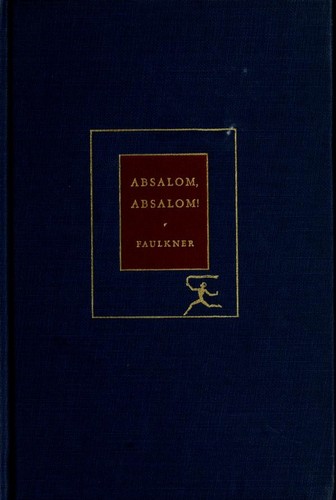
Absalom, Absalom!
William Faulkner · 1897–1962 · USA
Why it matters
Thomas Sutpen's design (a plantation dynasty willed out of nothing), reconstructed by narrators who weren't there, decades later, in a Harvard dorm. The South's original sin as epistemology: the great novel about how history is told.
At a glance
Nested, contradictory retellings and famously labyrinthine sentences make this Faulkner's hardest novel.
Deep dive
Four narrators, working decades after the fact and mostly from rumor, keep rebuilding the same ruined dynasty out of different guesses, and Faulkner never lets any single version stand as the truth.
Written for readers who have finished the book. No plot recap, and nothing here is safe to read first.
Themes & symbolism
Thomas Sutpen arrives in Yoknapatawpha with a wagonload of enslaved men, a captured French architect, and what the novel calls his design: a hundred square miles cleared from swampland, a mansion raised in two years of forced labor, a marriage to Ellen Coldfield chosen purely for respectability. The design answers one boyhood humiliation, being sent to a plantation's back door as a poor white child, and the book is the slow collapse of a man who tried to out-build a class insult with will alone, treating his wife, his children, and the people he enslaved as materials rather than people.
What actually brings the design down is the son Sutpen fathered in Haiti before the novel begins and discarded once he learned the boy's mother carried Black blood. Charles Bon drifts back as Henry Sutpen's college friend and Judith's suitor, and incest between half-siblings, the horror the novel spends hundreds of pages circling, turns out to be the more forgivable crime standing in front of the real one. Sutpen's own late, unashamed accounting treats the abandonment of a wife and child as a bookkeeping correction, and that flat arithmetic is the design's whole moral logic exposed.
Told by People Who Were Never There
Rosa Coldfield narrates from decades of curdled fury after being briefly, grotesquely propositioned by Sutpen following her sister's death. Mr. Compson supplies a cooler, more classical account inherited from his own father. Neither witnessed what they describe, and by 1910 Quentin Compson and his Harvard roommate Shreve McCannon have stopped relaying the story and started co-inventing it outright, supplying dialogue and private thought for Henry and Bon that no source could have given them. Their invented version feels truer than any secondhand testimony before it, which is the point: a region's founding myth survives only as an act of imaginative reconstruction, never as settled record.
Quentin's Inheritance
Quentin already exists as a character in The Sound and the Fury, where he drowns himself the same year he narrates this story, and Absalom, Absalom! works as an unstated prequel to that earlier, earlier-published novel, explaining the weight he's carrying into it. Listening to Rosa and his father recount the Sutpen catastrophe isn't nostalgia for Quentin, it's induction into an inheritance he can't refuse: a regional history built on slavery and denial that keeps producing sons who destroy each other over what blood is allowed to mean. His famous closing insistence that he doesn't hate the South, repeated until it reads as its own opposite, compresses the whole novel into one exhausted sentence.
The last seal: what actually happens, and why it lands the way it does.
The ending, explained
Bon's killing outside the gates, Henry firing on the friend and half brother he had defended through years of war, closes the plot without settling its real question: whether Henry was avenging incest, or something Sutpen told him about Bon's blood that made incest look like the lesser crime. Sutpen himself dies years later at the hands of Wash Jones, a poor tenant whose granddaughter Sutpen got pregnant and then discarded exactly as he once discarded Bon's mother, the design repeating its founding cruelty in miniature. Henry, returned home to die, burns with the mansion when Clytie, Sutpen's daughter by an enslaved woman, sets it alight rather than let outsiders take him. What survives is Jim Bond, Bon's grandson, howling among the ruins, the design's only actual heir.
Where to go next
 William Faulkner · 1929The Sound and the FuryLvl 10Slow burn
 William Faulkner · 1930As I Lay DyingLvl 9Medium pace
 William Faulkner · 1950Collected Stories of William FaulknerLvl 7Slow burn
 William Faulkner · 1954A FableLvl 9Slow burn
 William Faulkner · 1962The ReiversLvl 4Medium pace
 Cormac McCarthy · 1992All the Pretty HorsesLvl 6Medium pace