
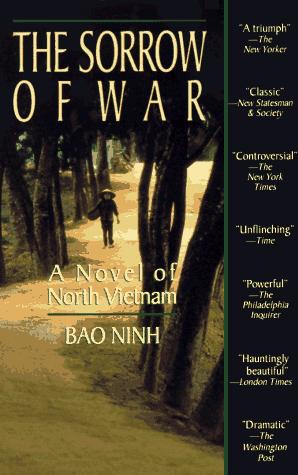
The Sorrow of War
Bảo Ninh · b. 1952 · Vietnam
Originally Nỗi buồn chiến tranh (Vietnamese) · translated by Phan Thanh Hảo & Frank Palmos
Why it matters
A shell-shocked veteran-novelist's memories of combat, loss, and a wartime love affair surface out of order, refusing any redemptive shape to his suffering. The rawest, least triumphant novel of the Vietnam War, acclaimed abroad and long controversial at home.
At a glance
Nonlinear, dreamlike structure moves between timelines without signposting, mirroring traumatic memory.
Deep dive
Why a Vietnamese war novel built from fragments instead of chronology was suppressed at home while winning acclaim everywhere else, and whose hand actually assembled the pages we're reading.
Written for readers who have finished the book. No plot recap, and nothing here is safe to read first.
Themes & symbolism
Kien fights with the 27th Battalion and survives a massacre so total that the site becomes known among soldiers as the Jungle of Screaming Souls, the wind through the trees remembered as the voices of the dead. Bảo Ninh refuses the chronological war novel almost entirely: combat, Kien's postwar wandering through Hanoi, and his prewar romance with Phương all interrupt each other mid-scene, because the book's real subject is what trauma does to time, not what happened in what order. A reader has to reconstruct Kien's war the way Kien does, in pieces that never quite reassemble into a story with a moral.
Phương is introduced as Kien's first love, luminous and reckless, and the war reaches her before it reaches him: assaulted on a train south while Kien, restrained by other passengers during an air raid, cannot stop it. Kien spends the rest of the book unable to separate his love for her from that failure, and Bảo Ninh is careful not to let Phương become simply his wound; she survives the war on her own terms, drifting through relationships Kien reads as betrayal, refusing to be the untouched girl he needs back.
Published Twice, Under Two Titles
Bảo Ninh served in the same 27th Battalion the novel maims almost to a man. When the book first appeared in Hanoi in 1990 it was titled Thân Phận Của Tình Yêu, The Fate of Love, a softer title chosen to help it clear censors still committed to a literature of victory rather than mourning; it won the Vietnam Writers' Association prize that year almost by surprise, before officials began quietly restricting it for describing the war's cost without redemption. Translated into English in 1993 as The Sorrow of War, and elsewhere as The Jungle of Screaming Souls, it became the first Vietnamese novel to reach a wide Western readership, arriving just as Western readers were reassessing their own war fiction, part of why it read, outside Vietnam, as the war's missing other half.
The last seal: what actually happens, and why it lands the way it does.
The ending, explained
Kien eventually disappears from the apartment building he has lived in since the war, leaving behind a suitcase of manuscript pages in no order at all. A mute woman who has lived in the building for years, and who has quietly loved Kien from a distance, gathers the scattered pages and spends months arranging them, guessing at connections the handwriting alone won't give her. The unnamed narrator framing the novel's opening and closing pages turns out to be the person who receives this reassembled manuscript from her, meaning the looping, disordered novel just finished is presented as Kien's own writing, recovered rather than composed, its structure a record of what trauma does to memory rather than a technique imposed on it from outside.
Where to go next
 Richard Ford · 1995Independence DayLvl 6Slow burn
 António Lobo Antunes · 1979The Land at the End of the WorldLvl 8Slow burn
 Joyce Carol Oates · 1969themLvl 6Medium pace
 Paul Harding · 2009TinkersLvl 6Slow burn
 Ernest Hemingway · 1926The Sun Also RisesLvl 4Fast paced
 Joan Didion · 1970Play It as It LaysLvl 6Fast paced