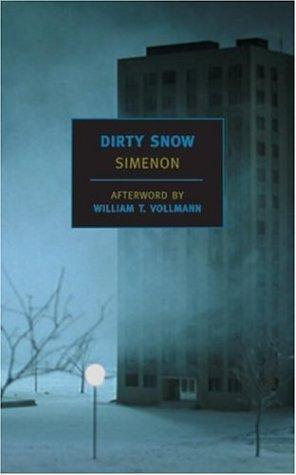
The Snow Was Dirty
Georges Simenon · 1903–1989 · Belgium
Originally La Neige était sale (French)
Why it matters
A young man in an occupied city drifts into petty crime and murder with chilling indifference. Simenon's bleakest 'roman dur' strips the crime novel down to pure moral desolation, with no detective in sight.
At a glance
Flat affectless prose masking a genuinely bleak moral interior.
Deep dive
A pimp's teenage son in an occupied city commits a senseless killing to prove he can, and Simenon spends the rest of the novel watching the act fail to make him feel anything at all.
Written for readers who have finished the book. No plot recap, and nothing here is safe to read first.
Themes & symbolism
Frank Friedmaier grows up literally above the brothel his mother Lotte runs in an occupied city Simenon never names, geography and even the occupying power kept deliberately vague so the moral rot on display can't be filed away as one specific nation's wartime aberration. Numb to the ordinary claims of decency around him, Frank stabs an enemy officer in the book's early pages for no motive the novel will fully justify, an act closer to a self-administered initiation, proof to himself that he can do it, than to political resistance or personal grievance.
Sissy Holst, the neighbor girl who loves him without reservation, becomes another object of the same experiment: Frank seduces her with the same detachment he brought to the killing, less desire than another test of what he can make himself do to another person. Her father, the dignified, quietly principled Holst, unsettles Frank precisely by embodying an integrity Frank has never had access to and half resents for existing, and Frank's carelessness with the family eventually delivers Holst into the hands of the authorities, a betrayal Frank barely registers as one when it happens. Simenon sets the whole novel inside a single hard winter, the title's dirtied snow piling in the streets as a visual correlative for a conscience that accumulates filth without ever being scraped clean.
An Occupation Novel That Refuses to Name the Occupier
Simenon wrote this in 1948, three years after an Occupation he had lived through in France under circumstances, including work for a German-linked production company, that drew postwar accusations of collaboration against him personally. The novel's refusal to name its city, its war, or its occupying power reads as a deliberate widening of the charge: this isn't an indictment of one army or one government but of what ordinary people, a mother running a brothel, a boy raised numb to consequence, become willing to do once occupation has already dissolved the usual rules, a case Simenon was making as much about himself and his own compromises as about Frank.
The last seal: what actually happens, and why it lands the way it does.
The ending, explained
Frank is finally arrested, not for the killing he committed early in the novel, which the authorities never connect to him, but for smaller, almost incidental offenses that catch up with him regardless, and Simenon lets the injustice of that mismatch sit unresolved rather than corrected. Under interrogation and in the cell that follows, Frank begins, for the first time in the book, to feel something like the guilt his numbness had kept at bay for hundreds of pages, particularly toward Sissy and toward Holst, whose ruin he caused almost carelessly. The novel closes on Frank facing execution having finally located a conscience only once punishment made it useless to him, Simenon's bleakest possible answer to the question of what it actually takes to make a boy like Frank feel anything at all.