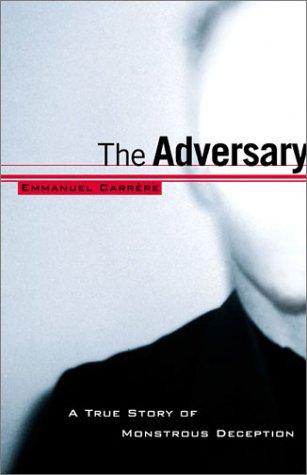
The Adversary
Emmanuel Carrère · b. 1957 · France
Originally L'Adversaire (French) · translated by Linda Coverdale
Why it matters
Respectable doctor Jean-Claude Romand maintained an entire fake medical career for eighteen years before murdering his wife, children, and parents rather than admit the lie. Carrère's landmark 'nonfiction novel' narrates the crime while confessing his own uneasy fascination with it.
At a glance
Plain, controlled prose, though its blend of true crime and self-implicating narration unsettles genre expectations.
Deep dive
A respected doctor's entire career, referrals, and research funding were invented from nothing and maintained for eighteen years. Carrère's 'nonfiction novel' follows the lie to where it had to end, and confesses his own discomfort at being drawn to it.
Written for readers who have finished the book. No plot recap, and nothing here is safe to read first.
Themes & symbolism
Romand's real crime, in Carrère's telling, long precedes the murders: it's the eighteen years of maintaining a total fiction — driving off each morning to sit in a parking lot or a forest pretending to commute to a WHO research post he never held, extracting money from family and friends under the pretense of investing it, sustaining an entire adult identity with no factual content whatsoever. Carrère treats this daily discipline of fabrication as its own species of monstrous achievement, a negative sublime that dwarfs any single dramatic deception; the murders that eventually follow, when the lie's collapse becomes unavoidable, read almost as an afterthought next to the sheer scale of what had already been sustained for nearly two decades.
What makes the book unusual, and uncomfortable, is Carrère's refusal to stand outside the story as a neutral reporter. He'd been separately approached to write a novel on roughly this premise before Romand's crime actually happened, an uncanny coincidence he doesn't hide, and he narrates his own years of correspondence and prison interviews with Romand as a compromised, self-implicating process — repeatedly interrupting the account of the case to interrogate his own fascination, his doubts about profiting from a family's murder, and his inability to resolve whether understanding a man like Romand is even a legitimate project or a kind of complicity with him.
The Nonfiction Novel as Confession
Carrère borrows Capote's true-crime form but strips it of Capote's authorial invisibility: where In Cold Blood hides its narrator's hand, The Adversary keeps foregrounding Carrère's uncertainty, guilt, and stalled progress on the manuscript itself, turning the writing process into part of the subject. The effect is less a portrait of a murderer than a portrait of the difficulty, maybe the impossibility, of writing about one without becoming implicated in his need to be understood. Carrère has said the book took years to write partly because he kept losing the ethical footing to write it at all, a hesitation the finished text incorporates rather than smooths over, making his own doubt as much a formal feature of the book as Romand's fabricated résumé.
The last seal: what actually happens, and why it lands the way it does.
The ending, explained
Carrère narrates the killings of Romand's wife, children, and parents with clinical restraint rather than sensational detail, in keeping with the book's refusal to aestheticize the violence. Romand's own attempt to die alongside them, by setting his house on fire, fails; he stands trial and receives a life sentence, and later professes what reads, to Carrère, as a sincere but unverifiable religious conversion in prison. Carrère closes the book still unable to resolve his own ambivalence — neither willing to grant Romand the clean absolution of repentance nor content to dismiss him as simply a monster — ending on the same essayistic uncertainty that has run under the whole narrative rather than any settled verdict.