
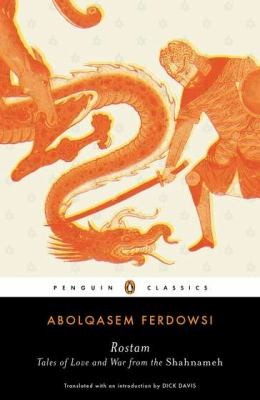
The Shahnameh
Abolqasem Ferdowsi · 940 CE–1020 · Persia
Originally Shahnameh (Persian) · translated by Dick Davis
Why it matters
Fifty kings, mythic and historical, march through fifty thousand couplets of creation, conquest, and tragedy. Ferdowsi's epic single-handedly kept the Persian language alive under Arab rule, still the touchstone of Iranian identity.
At a glance
Vast cast and mythic-to-historical scope across a huge verse epic, though individual episodes read clearly.
Deep dive
Why a poet spent thirty years chronicling fifty kings who barely needed saving, and what happens in the one episode where a father meets a son he's never seen — across a battlefield.
Written for readers who have finished the book. No plot recap, and nothing here is safe to read first.
Themes & symbolism
The throughline across fifty thousand couplets isn't any single king but farr, the divine glory that legitimizes rule and can be forfeited: Jamshid loses it to pride and is sawn in half by a usurper, and the pattern repeats across the epic's mythical, heroic, and historical ages until kingship itself starts to look less like inheritance than probation. Ferdowsi is relentlessly unsentimental about power — even his greatest heroes serve shahs who don't deserve them, and the poem's tragic engine is watching loyalty outlast the throne's worth.
Ferdowsi wrote in deliberately "clean" Persian, scrubbed of the Arabic vocabulary flooding the language after the Islamic conquest, and said so explicitly: "I have built a lofty palace of poetry that wind and rain won't harm." That's not a boast so much as a mission statement — reviving pre-Islamic, Zoroastrian-inflected myth and kingship legend at a moment when Persian identity had every reason to dissolve into its conquerors' culture. The epic became the thing it describes: a monument that outlived the empire it was written under.
Rostam and Sohrab: A Father's Blindness
The epic's most-cited episode inverts its own heroic logic. Rostam, Iran's greatest champion, fathers a son, Sohrab, during a brief liaison he never follows up on; the boy grows up strong enough to threaten Iran itself, searching for the father he's never met. The two meet as enemies on the battlefield, each disguising or mistaking the other's identity through a chain of small, devastating failures — a token Sohrab's mother gave him to prove his lineage, checked one moment too late. Rostam kills his own son and only then learns who he was. It's the poem's bluntest statement that the machinery of dynastic war grinds up ordinary families along with kings, and that the hero whose whole identity is built on recognizing enemies can be blind to the one person he shouldn't be fighting at all.
Ferdowsi refuses to let the court's paranoia off the hook, either: the Persian king Kavus, warned that Sohrab might be Rostam's son and fearing what a reunited father and son could do to his own throne, actively withholds the information that might have stopped the duel. Grief this large doesn't stay contained to one family in the Shahnameh's moral universe — it's presented as a direct cost of the same kingship politics the rest of the epic spends its length dramatizing, the throne protecting itself at the price of the one household it should have safeguarded.
A Book Built to Outlast an Empire
Ferdowsi worked for roughly three decades, largely without the patronage he'd hoped for — the Ghaznavid sultan Mahmud reportedly paid him a fraction of the promised reward, provoking a satire so bitter Ferdowsi is said to have fled the court rather than face reprisal. The gamble paid off on a longer timescale than any single patron: the Shahnameh became the text ordinary Persian speakers memorized, performed in coffeehouses and traditional gymnasiums, and still quote today, the single most durable vehicle for Persian language and pre-Islamic identity to survive Arab, Turkic, and Mongol rule alike. Matthew Arnold's Sohrab and Rustum, drawn straight from Ferdowsi, is one small sign of how far that survival traveled.
Where to go next
 Farid ud-Din Attar · 1177The Conference of the BirdsLvl 6Slow burn
 Johannes V. Jensen · 1922The Long JourneyLvl 6Medium pace
 Larry McMurtry · 1985Lonesome DoveLvl 5Fast paced
 The Arabian Nights Compilers · 850 CEOne Thousand and One NightsLvl 4Fast paced
 The Beowulf Poet · 1000BeowulfLvl 6Medium pace
 Ivo Andrić · 1945The Bridge on the DrinaLvl 4Slow burn