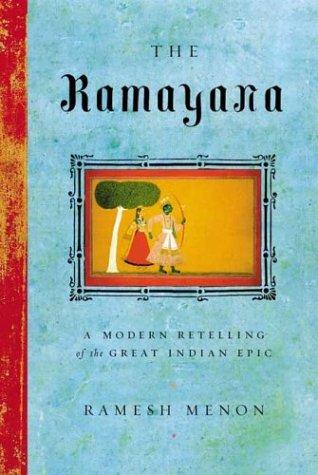
The Ramayana
Valmiki · 400–320 BCE · Ancient India
Originally The Ramayana (Sanskrit)
Why it matters
Prince Rama is exiled, his wife Sita abducted by a demon king, and an army of monkeys and bears joins the war to win her back. One of the two great Sanskrit epics: its characters and moral vocabulary still alive across South and Southeast Asia today.
At a glance
Long oral-epic verse structure and a huge cast, though the central quest narrative is clear throughout.
Deep dive
Why the version most people know ends at a coronation, and what the darker, disputed continuation almost everyone has also heard does to that ending.
Written for readers who have finished the book. No plot recap, and nothing here is safe to read first.
Themes & symbolism
Rama's defining trait is neither cunning nor passion but an almost inflexible fidelity to dharma, duty tied to role: he accepts fourteen years of exile because his father once promised it to a jealous stepmother, and refuses at several points to simply seize the throne that's rightfully his, because doing so would violate the order he's sworn to uphold. That constraint is the whole point of calling him maryada purushottama, 'the finest of those who uphold limits' — his heroism is measured by what he refuses to do, not by what he conquers.
Ravana complicates what could have been a simple contest of good against evil: he's a Brahmin by birth, a scholar of the Vedas, and a devotee of Shiva whose learning and power are never in dispute, only his pride and desire. Rama's war against him plays out less as virtue against monstrosity than as dharma against adharma, right action against a genuinely formidable wrong one — the epic needs Ravana's stature intact for Rama's restraint to mean anything.
Even the epic's 'happy' core ending carries its dark undertow already built in: after Ravana's defeat, Rama publicly questions Sita's chastity following her months in captivity, and she undergoes agni pariksha, a trial by fire, to prove her purity before the fire god Agni himself vouches for her and the couple returns in triumph to be crowned in Ayodhya. Suspicion of Sita, in other words, isn't a later corruption of a pure ending — it's present at the coronation that most retellings treat as the finish line.
The Uttara Kanda Question
Books one through six of Valmiki's epic, ending in Rama and Sita's coronation, are generally regarded by scholars as the core narrative; the seventh book, the Uttara Kanda, is widely considered a later addition, composed after the main story had already circulated, and its status as canonical or secondary remains genuinely disputed. It reopens everything the coronation seemed to settle: rumors persist among Ayodhya's citizens about Sita's fidelity during her captivity, and Rama, now king and bound by duty to his subjects' judgment rather than his own conviction of her innocence, banishes the pregnant Sita to the forest. She raises their twin sons, Lava and Kusha, alone, and is eventually reunited with Rama when the grown boys perform his own epic before him without either side at first knowing who the other is. Confronted again with demands to prove her purity, Sita instead asks the earth, her mother Bhumi, to receive her — and the ground opens and swallows her, a vindication that is also a final refusal to keep proving anything. In some tellings, a griefstricken Rama later walks into the Sarayu river himself. Whether this coda belongs to 'the' Ramayana or stands as an accretion has been argued for centuries, but it's the version most subsequent retellings, and most modern critical rereadings of Sita's treatment, actually engage with.
One Epic, Many Ramayanas
Valmiki's Sanskrit text is the earliest known version but hardly the only one: Kamban's Tamil Ramavataram, Tulsidas's Awadhi Ramcharitmanas, and Southeast Asian tellings such as Thailand's Ramakien each reweight the story's emphasis, sometimes softening Sita's banishment or foregrounding different characters' devotion, so that 'the Ramayana' is better understood as a living, regionally reinterpreted tradition than a single fixed text — which is exactly why its vocabulary of duty, exile, and devotion still circulates so widely across South and Southeast Asia today.