
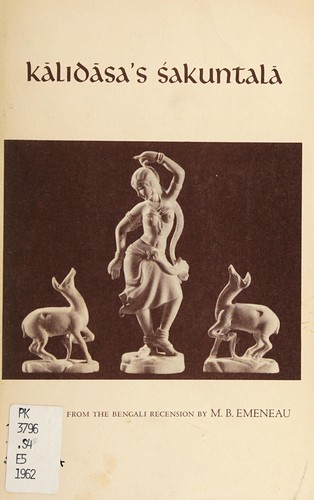
The Recognition of Shakuntala
Kalidasa · 375 CE–455 CE · Gupta India
Originally The Recognition of Shakuntala (Sanskrit)
Why it matters
A king falls for a hermitage girl, marries her in secret, then a sage's curse wipes her from his memory, leaving her to face his court alone. Classical Sanskrit drama's most celebrated play, the work that first won Kalidasa a European readership through Goethe's praise.
At a glance
Dense classical Sanskrit poetic diction in translation, though the plot itself is compact and clear.
Deep dive
A curse that only needed a piece of jewelry to break — and the small, devastating window in which the ring simply isn't there.
Written for readers who have finished the book. No plot recap, and nothing here is safe to read first.
Themes & symbolism
The play's entire machinery turns on forgetting and recognition (pratyabhijna): Dushyanta's curse doesn't erase Shakuntala from the world, only from his memory, which makes his rejection of her worse rather than better — he isn't a villain refusing his wife, he's a man telling the truth as he currently, wrongly, knows it. Kalidasa stages this as tragedy of circumstance rather than of character: Durvasa's curse lands because Shakuntala is too lovesick to properly attend a guest, a fault so minor it barely counts as one, and the softened condition — that a token can restore memory — turns the whole plot on an object as fragile and losable as a ring slipped off in a river.
The hermitage forest, where Shakuntala grows up in intimacy with animals and ascetics, stands against the court as an idealized space of innocence and directness, and her humiliation begins the moment she leaves it to claim a courtly identity that requires proof, witnesses, and a king's memory rather than simply love. The play's insistence on restoration over catastrophe — the family made whole again rather than destroyed — is characteristic of Sanskrit dramatic convention generally, which favors reconciliation as its natural end the way Greek tragedy favors ruin.
Goethe's Play
No Sanskrit drama traveled further into European letters than this one. Goethe read it in translation and was reportedly moved to wish, in a famous verse, that a single word could name a work uniting heaven and earth, youth's blossoms and age's fruit, as this play did — and his enthusiasm helped cement Kalidasa's reputation among European Romantics starved for models of a literature that could hold pastoral tenderness and courtly grandeur in the same frame. The play's structure, particularly its handling of nature as a moral register for its characters, left visible fingerprints on how German Romanticism thought about the relationship between innocence, landscape, and civilization.
Part of what travelled so well was the play's refusal to villainize anyone: Dushyanta's forgetting isn't a moral failure but a curse, Shakuntala's slip isn't malice but distraction, and even Durvasa's rage is softened by the escape clause his companions beg out of him. European readers used to tragedy built on deliberate wrongdoing found in Kalidasa a different, gentler model of dramatic suffering — one caused by chance, curse, and circumstance rather than by anyone's cruelty.
The last seal: what actually happens, and why it lands the way it does.
The ending, explained
A fisherman is arrested trying to sell a ring he found inside a fish, and brought before Dushyanta on suspicion of theft — the ring is Shakuntala's, and the instant the king sees it, the curse breaks and his memory of her floods back, along with the full horror of having publicly disowned his own pregnant wife. Years pass before the reunion actually happens: Dushyanta, returning from a campaign assisting the gods, encounters a fearless boy playing with a lion cub in a hermitage garden and marked with signs of royal destiny. The boy is Bharata, his and Shakuntala's son (the name later lending itself to India's own name, Bharatavarsha), and through this chance meeting father, mother, and son are restored to each other. The ending lands as vindication rather than justice exactly earned — the curse's damage is undone by luck and time as much as by anyone's effort, which is the point: memory failed Shakuntala, and only accident repairs what memory broke.
Where to go next
 Valmiki · 400 BCEThe RamayanaLvl 5Fast paced
 Vyasa · 300 BCEThe MahabharataLvl 8Medium pace
 Sarat Chandra Chattopadhyay · 1917DevdasLvl 2Fast paced
 Rabindranath Tagore · 1916The Home and the WorldLvl 6Medium pace
 William Shakespeare · 1601HamletLvl 6Medium pace
 Alessandro Manzoni · 1827The BetrothedLvl 5Medium pace