
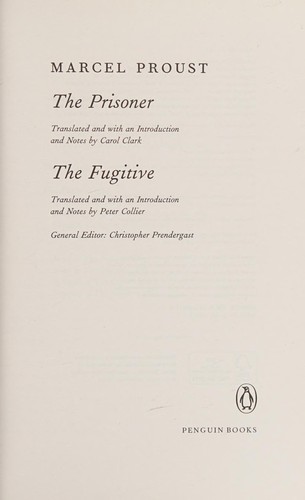
The Prisoner
Marcel Proust · 1871–1922 · France
Originally La Prisonnière (French)
Why it matters
The narrator keeps Albertine as a virtual captive in his Paris apartment, and jealousy curdles into the novel's most claustrophobic study of how possessing someone guarantees you'll never truly know them. Published posthumously, unrevised.
At a glance
Airless, obsessive interiority with almost no external event to anchor it.
Deep dive
The narrator finally has Albertine exactly where he wants her, living under his own roof, and discovers that total access cures nothing about the suspicion that put her there.
Written for readers who have finished the book. No plot recap, and nothing here is safe to read first.
Themes & symbolism
Having installed Albertine in his Paris apartment under his servant Françoise's watchful disapproval, the narrator now controls nearly everything about her days, choosing which outings she's allowed, reading her mail, questioning her chauffeur about her routes. Proust uses the arrangement to show that jealousy isn't actually about information: knowing where Albertine is every hour doesn't produce trust, it only produces more elaborate grounds for doubt, since a captive can lie as easily as a free woman and the narrator's mind treats every unaccounted minute as evidence regardless of the facts in front of him. Possession, complete as Proust can make it, turns out structurally incapable of satisfying the appetite that demanded it in the first place.
The street cries rising up from below his window, a cheese seller, a chair mender, a woman selling snails, become a running motif of the outside world's continued, indifferent motion while the narrator keeps Albertine indoors with him, each vendor's call a small reminder of a Paris he's chosen to give up in exchange for a surveillance that isn't even working. He listens to those cries the way he listens for Albertine's footsteps down the hall, straining an idle morning into another exercise in vigilance, and Proust lets the comedy of the vendors' sung offerings sit right beside the narrator's genuine misery without softening either one. Morel's performance of Vinteuil's septet at the Verdurins', a late, elaborate piece reconstructed after the composer's death by his daughter's friend from fragmentary manuscripts, gives the volume its clearest counterexample: a private, half-illegible score is patiently deciphered and made public years after Vinteuil died believing himself a failure, the exact reversal of what jealousy is doing to the narrator's own private, half-legible relationship with Albertine.
Françoise's Silent Verdict
The servant Françoise says almost nothing directly about Albertine's presence in the household, but Proust lets her disapproval register anyway, in the stiffness of a served meal, a door left pointedly open, a look withheld rather than given, class antagonism voiced entirely through gesture rather than speech. She functions as an alternative judge sitting outside the narrator's obsessive interiority, one who sees the arrangement for what it plainly is, a young woman confined rather than loved, without needing a single line of dialogue to say so, and her silence carries more moral weight than anything the narrator tells himself.
The last seal: what actually happens, and why it lands the way it does.
The ending, explained
The volume ends in five words: Françoise announces that Mademoiselle Albertine has left, gone in the early morning while the narrator slept, taking her things with her and leaving no note beyond a brief, formal farewell. After hundreds of pages devoted to controlling her every movement, the captivity ends not with a confrontation but with an absence discovered secondhand, from a servant, after the fact, the narrator's elaborate surveillance revealed as having secured nothing at all in the one moment it mattered, the door he thought he'd locked simply walked through while he slept.
Where to go next
 Marcel Proust · 1913Swann's WayLvl 8Slow burn
 Marcel Proust · 1919In the Shadow of Young Girls in FlowerLvl 9Slow burn
 Marcel Proust · 1920The Guermantes WayLvl 9Slow burn
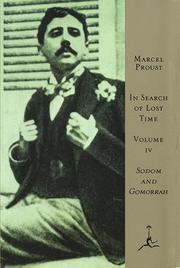 Marcel Proust · 1921Sodom and GomorrahLvl 9Slow burn
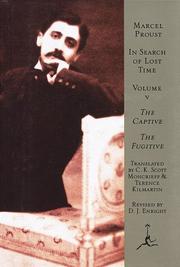 Marcel Proust · 1925The FugitiveLvl 8Slow burn
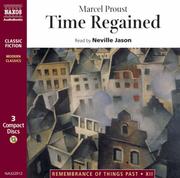 Marcel Proust · 1927Time RegainedLvl 9Slow burn