
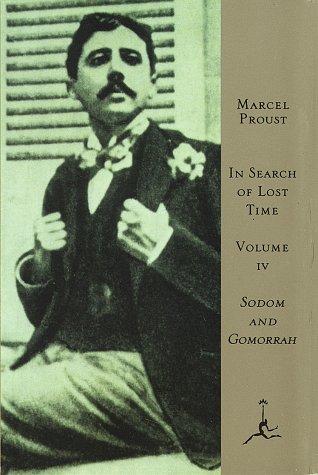
Sodom and Gomorrah
Marcel Proust · 1871–1922 · France
Originally Sodome et Gomorrhe (French)
Why it matters
Proust turns his anatomy of desire toward homosexuality, unmasking the Baron de Charlus's secret life and igniting the narrator's ruinous obsession with Albertine. Society itself starts to look staged, everyone playing a part they never chose.
At a glance
Dense digressions on desire and disguise complicate an already elaborate social plot.
Deep dive
A courtyard, a bumblebee, and an aristocrat caught in an encounter that reorganizes everything the narrator thought he understood about the people he's spent five hundred pages admiring.
Written for readers who have finished the book. No plot recap, and nothing here is safe to read first.
Themes & symbolism
The volume opens with the narrator secretly watching the Baron de Charlus and the tailor Jupien meet in a courtyard, an encounter Proust narrates through an extended botanical conceit, comparing Charlus to a rare flower and Jupien to the specific insect it has evolved over generations to attract, so that what the scene announces reads less like a private vice than a natural process the narrator has simply never been positioned to notice before. From here Charlus's set becomes visible throughout the book as a hidden nation grafted onto the aristocracy the narrator already toured in the previous volume, present all along in plain sight and unread until now.
Back at Balbec, the narrator's jealousy over Albertine intensifies not because of anything she does but because of one remark: she mentions knowing the friend of the dead composer Vinteuil's daughter, the same woman glimpsed years earlier at Montjouvain in Swann's Way, desecrating Vinteuil's photograph with her lover in front of an open window. The narrator's mind supplies the rest instantly and without evidence, jealousy here working less like a response to observed facts than like a machine that manufactures its own fuel out of a single overheard name.
The Verdurins' salon at La Raspelière, a rented country house full of the same petty tyrannies and forced loyalty tests as their earlier Paris gatherings, functions as a bourgeois double of the Guermantes world, complete with its own version of Charlus, now humiliatingly fixated on the violinist Morel and prepared to debase himself, socially and financially, to keep the younger man close, proof that status and self-command are no protection against desire once it takes hold of someone who has spent a lifetime commanding everyone else.
The Bee and the Orchid
Proust extends the Charlus-Jupien scene's insect imagery for pages, drawing on the same nineteenth-century natural history, Darwin's work on orchid fertilization among it, that framed desire between men as a matter of botany rather than morality, a deliberate move that lets him describe what contemporary law and church both condemned in the calm, clinical register usually reserved for science rather than scandal. The effect is to naturalize Charlus rather than excuse him; Proust is not asking for sympathy so much as insisting that what the narrator has just seen has always been part of the ecosystem he's been describing for five volumes, hidden only because he lacked the vocabulary, and the invitation, to see it.
Where to go next
 Marcel Proust · 1913Swann's WayLvl 8Slow burn
 Marcel Proust · 1919In the Shadow of Young Girls in FlowerLvl 9Slow burn
 Marcel Proust · 1920The Guermantes WayLvl 9Slow burn
 Marcel Proust · 1923The PrisonerLvl 9Slow burn
 Marcel Proust · 1925The FugitiveLvl 8Slow burn
 Marcel Proust · 1927Time RegainedLvl 9Slow burn