
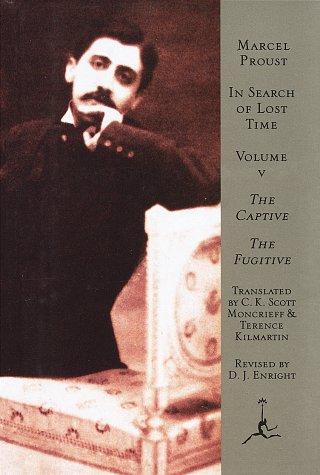
The Fugitive
Marcel Proust · 1871–1922 · France
Originally Albertine disparue (French)
Why it matters
Albertine flees and dies offstage, and the narrator's grief becomes a case study in how completely memory can outlast the person it clings to, and how indifference eventually replaces even the deepest pain. Also published as Albertine Gone.
At a glance
Shorter and more emotionally direct, though still tracking grief's minute fluctuations.
Deep dive
Grief that refuses to arrive on schedule, and how a boy's oldest, most private fantasy of a city finally gets visited only once it no longer means anything.
Written for readers who have finished the book. No plot recap, and nothing here is safe to read first.
Themes & symbolism
Proust calls the uneven fading of loss "the intermittencies of the heart": the narrator expects grief to move in one direction, and instead finds it arriving in waves that get sharper before they get duller, ambushing him over a stray phrase or a piece of furniture long after he thought himself recovered, and receding, in the end, not because he resolves anything but simply because enough time accumulates between him and the memory. He sends Saint-Loup to track down and negotiate with Albertine before the news of her death even arrives, an errand that becomes retroactively unbearable once it can no longer be completed, evidence of how much of grief is simply unfinished business with no one left to finish it with.
Fresh information about Albertine's secret life keeps surfacing throughout the volume, further testimony from Andrée and others essentially confirming what the narrator had only ever suspected, and each new fact lands with less force than the last, arriving too late to feed a jealousy that has already begun, on its own schedule, to starve. Venice, imagined since childhood as the destination that would finally satisfy the narrator's whole capacity for longing, gets visited at last in this same volume, and the visit completes rather than breaks the pattern set as far back as Swann's Way: anticipation was always doing more work than the actual place ever could.
The Two Ways Meet
Gilberte Swann, now married to Robert de Saint-Loup, turns the narrator's childhood geography from Swann's Way into an actual fact of family: the Méséglise way, associated with the Swanns, and the Guermantes way, associated with Robert's noble family, converge in a single marriage the boy who once thought them permanently separate could never have predicted, and who spends this whole volume slowly realizing it.
Saint-Loup's Own Secret
Robert de Saint-Loup's marriage to Gilberte turns out to be shadowed by affairs of his own, including with Morel, the same violinist who has already humiliated Charlus in the previous volumes, extending the novel's argument that desire outside the sanctioned lines runs through this entire social world rather than isolating one eccentric baron, and quietly wrecking a marriage the narrator had assumed, from the outside, was settled and safe.
The last seal: what actually happens, and why it lands the way it does.
The ending, explained
By the time the narrator reaches Venice, the labor of forgetting Albertine is essentially finished, and the city he'd dreamed about since Combray registers as pleasant rather than transcendent, proof that no place could have carried the weight his imagination once assigned it. Gilberte, now unhappily married, confesses that she had wanted the narrator herself as a girl, back when he read her indifference as final, a piece of news that arrives with the same uselessness as everything else learned too late in this volume. The book closes with Saint-Loup's marriage quietly failing and the narrator's own longest attachment reduced to a settled, unremarkable fact of his past rather than an open wound.
Where to go next
 Marcel Proust · 1913Swann's WayLvl 8Slow burn
 Marcel Proust · 1919In the Shadow of Young Girls in FlowerLvl 9Slow burn
 Marcel Proust · 1920The Guermantes WayLvl 9Slow burn
 Marcel Proust · 1921Sodom and GomorrahLvl 9Slow burn
 Marcel Proust · 1923The PrisonerLvl 9Slow burn
 Marcel Proust · 1927Time RegainedLvl 9Slow burn