
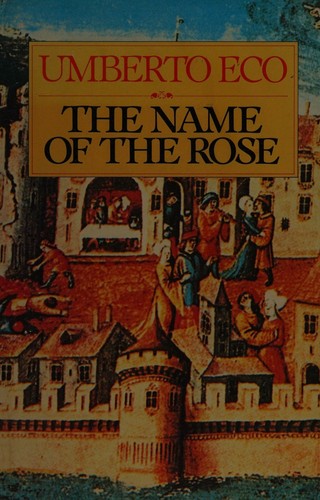
The Name of the Rose
Umberto Eco · 1932–2016 · Italy
Originally Il nome della rosa (Italian) · translated by William Weaver
Why it matters
A medieval monastery, a series of murders, and a labyrinthine library where a forbidden book kills its readers. Eco smuggled semiotics and a defense of laughter inside an irresistible detective story.
At a glance
Dense theological digressions, Latin phrases, and semiotic layering slow every chapter.
Deep dive
A murder mystery set off by a joke book Aristotle may or may not have written, in an abbey whose blind librarian has decided laughter itself is heretical.
Written for readers who have finished the book. No plot recap, and nothing here is safe to read first.
Themes & symbolism
Eco stages the whole plot as an argument about interpretation: William of Baskerville solves the killings using proto-empirical deduction, reading tracks, patterns, and signs the way a detective or a semiotician would, while the abbey around him insists that all meaning already flows downward from scripture and authority, with no legitimate room for a monk to reason his own way to truth. The murders turn out to hinge on exactly this tension — men dying to protect, or to destroy, a single forbidden book — which makes the mystery plot and the novel's real subject, the danger and necessity of unauthorized reading, the same story told twice.
Jorge of Burgos, the blind ex-librarian poisoning the pages of Aristotle's lost treatise on comedy, believes laughter is theologically catastrophic — that if comedy is granted philosophical legitimacy, it will dissolve the fear that keeps the faithful obedient, since a Christian who can laugh at doctrine is a Christian no longer fully controlled by it. Eco doesn't caricature the position; Jorge's logic is internally coherent and historically grounded in real medieval anxieties about mirth, which is what makes him a genuinely frightening antagonist rather than a simple villain — he's defending something he believes, correctly by his own lights, cannot survive being laughed at.
The library itself, a labyrinth built to be nearly unnavigable, encodes the abbey's whole philosophy of knowledge: information that exists but is deliberately made almost impossible to reach, hoarded rather than circulated, its architecture a physical argument that some truths are too dangerous for general access. William's ability to map and eventually penetrate it is inseparable from the novel's larger case for reason and curiosity over hoarded, fear-based authority.
A Postmodern Novel in Medieval Dress
Eco, a semiotician by trade, frames the whole book as Adso's own manuscript, filtered through a chain of supposed later transcriptions and translations that the fictional preface openly admits might be unreliable or even fabricated — a scholarly apparatus of doubt wrapped around a medieval murder mystery. The device lets a genre novel double as a meditation on how texts survive, get altered, and lose certainty across centuries of copying, which is exactly the fate that befalls the murder weapon at the story's center: a book whose original meaning is destroyed along with its only surviving copy.
The last seal: what actually happens, and why it lands the way it does.
The ending, explained
Confronted at last, Jorge admits he has spent years poisoning the pages of Aristotle's book on comedy so that whoever transgressively read it, licking a finger to turn each page, would die from the toxin before finishing it — and rather than surrender the volume to William, he begins tearing out and eating the poisoned pages himself while knocking over William's lantern. The resulting fire, fed by the labyrinth's oil and manuscripts, becomes unstoppable and consumes the library and much of the abbey over three days, destroying centuries of irreplaceable texts along with the one Jorge died protecting. William and Adso escape with only a handful of salvaged fragments, having solved the crime too late to prevent its underlying catastrophe. Adso's aged, retrospective closing line — 'stat rosa pristina nomine, nomina nuda tenemus,' the rose of old remains only in its name, we hold only naked names — turns the entire mystery into an elegy for everything language and memory can no longer actually recover.
Where to go next
 Umberto Eco · 1988Foucault's PendulumLvl 9Slow burn
 Italo Calvino · 1972Invisible CitiesLvl 5Slow burn
 Jorge Luis Borges · 1944FiccionesLvl 7Slow burn
 Thomas Pynchon · 1966The Crying of Lot 49Lvl 8Medium pace
 W. G. Sebald · 1995The Rings of SaturnLvl 7Slow burn
 Roberto Bolaño · 1998The Savage DetectivesLvl 7Medium pace