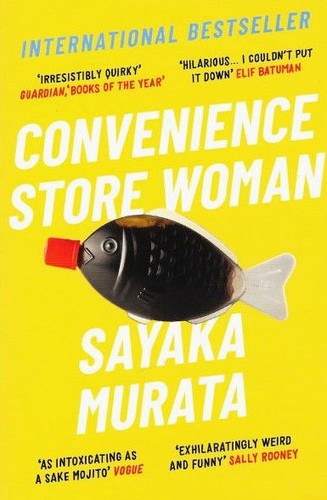
Convenience Store Woman
Sayaka Murata · b. 1979 · Japan
Originally Konbini Ningen (Japanese) · translated by Ginny Tapley Takemori
Why it matters
A woman finds her only true sense of belonging inside a convenience store's rigid scripts and rules, resisting family pressure to want anything more. Deadpan contentment as its own quiet rebellion against social conformity.
At a glance
Short, flat, deadpan first-person prose with a simple, direct plot.
Deep dive
Why an eighteen-year veteran of the same convenience store keeps finding, and losing, reasons to want a different life.
Written for readers who have finished the book. No plot recap, and nothing here is safe to read first.
Themes & symbolism
Keiko Furukura has worked the same Smile Mart shift since the store opened, and Murata is precise about what that job actually gives her: a manual. Every gesture, greeting, and vocal pitch is specified in advance, and Keiko, who as a child responded to a schoolyard fight by hitting a boy with a shovel and to a screaming baby by suggesting someone silence it outright, has spent her adult life discovering that only the store's exhaustive rulebook tells her, reliably, what a normal person is supposed to do next. She copies her coworkers' inflections and wardrobe choices the way an actor studies blocking, and the novel treats this not as pathology dressed up sympathetically but as the most honest account of socialization anyone in the book offers.
Shiraha, fired from the same store for stalking a customer, moves into Keiko's apartment less as a partner than as a parasite, arguing that her thirty-six years of unmarried convenience-store work mark her as more suspect, in the eyes of both their families, than his own unemployment and resentment. Murata uses him as a bitter, occasionally very funny mouthpiece for the exact social pressure the novel is dismantling, the assumption that any life is more legitimate than a store clerk's as long as it comes with a spouse or a title attached. The joke is that his contempt requires her cover far more than she requires his.
Keiko's Childhood Case File
The novel opens its account of Keiko's childhood almost clinically: the shovel, the choking suggestion, a string of literal-minded solutions to problems everyone around her expected to be handled with words rather than immediate action. Her family responds by treating her as something to be corrected rather than understood, and Murata is careful never to frame Keiko's logic as malicious. It is simply unfiltered by the unwritten social conventions everyone else absorbs without noticing they're doing it, which is exactly the deficit the convenience store, with its written manual for every interaction, turns out to repair.
Shiraha's Cave Man Theory
Shiraha's rants about a society that hasn't evolved past Stone Age mating and hunting hierarchies, delivered at length and with real self-pity, are meant to sound pathetic, and they do. Murata's trick is letting his diagnosis of social conformity be more or less accurate even while his character remains contemptible, so the reader can't dismiss the critique just because the messenger is repellent. He's proof that resentment of a system can coexist with total dependence on exploiting it.
The last seal: what actually happens, and why it lands the way it does.
The ending, explained
Pressured by Shiraha and her own family into treating the store as something to graduate from, Keiko quits and interviews for an office job, growing visibly ill in the process. In a family restaurant bathroom, she overhears the rhythmic beeps and calls of a convenience store through the wall and has what the novel plays as a genuine physical revelation rather than a metaphor: her body is built for that specific, structured environment, down to the cellular level, as she puts it. She abandons Shiraha and the arrangement built around hiding her from scrutiny, and resolves to return to store work the next morning. Murata refuses to frame this as either triumph or tragedy. It's simply Keiko choosing, finally and without apology, the one place she has ever been legible to herself.