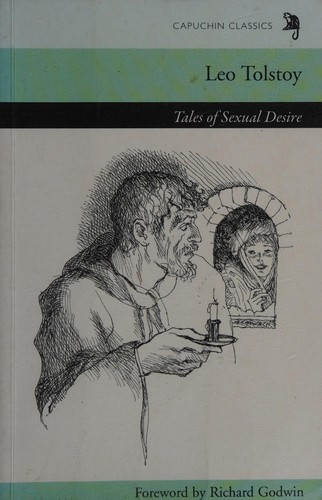
The Kreutzer Sonata
Leo Tolstoy · 1828–1910 · Russia
Originally Kreytserova Sonata (Russian)
Why it matters
A man confesses on a night train to murdering his wife in a jealous rage, unspooling a scalding indictment of marriage, lust, and the sexes' mutual contempt. So scandalous it was banned by Russian censors on first release.
At a glance
A short, feverish first-person confession, though its sexual frankness and misogyny unsettle.
Deep dive
A stranger on a train interrupts a polite conversation about love and marriage to confess, at length and without asking permission, exactly how his own marriage ended, and why he no longer believes marriage should exist at all.
Written for readers who have finished the book. No plot recap, and nothing here is safe to read first.
Themes & symbolism
Pozdnyshev boards a train, overhears fellow passengers discussing love and matrimony in comfortable generalities, and hijacks the conversation to tell the true story none of them are prepared for: his own marriage, poisoned from the start by a mutual attraction he now insists was never more than physical appetite dressed up as romance, curdling over years into jealousy, contempt, and finally a murder he committed himself. Tolstoy structures the entire novella as this single, unbroken confession, letting Pozdnyshev's argument build its own momentum until his conclusions, however extreme, arrive with the force of something worked out rather than simply asserted.
The novella takes its title from the Beethoven sonata Pozdnyshev's wife performs with the violinist Trukhachevsky, a shared passion for the piece that Pozdnyshev reads, retroactively, as evidence of an affair he cannot actually prove and does not particularly want proof of, since suspicion alone gives him license for the violence he was already primed to commit. Tolstoy is less interested in whether the wife was unfaithful than in what Pozdnyshev's jealousy reveals about how he had regarded her all along, as property whose loyalty was owed to him rather than a person capable of her own inner life, a possessiveness the marriage had simply dressed up as love until the music gave it an excuse to show itself plainly.
A Novella Tolstoy's Own Church Tried to Ban
The Kreutzer Sonata arrives with a coda, in the form of an afterword Tolstoy wrote to clarify that Pozdnyshev's extremism, including his argument that celibacy is preferable even within marriage, reflected the author's own late-life convictions rather than a character's derangement to be judged from a safe narrative distance. Russian censors banned the story outright on first submission, appalled by its frank treatment of sexual jealousy and its implicit attack on the institution of marriage the Orthodox Church sanctified; it circulated for a time only in hand-copied manuscript before Tolstoy's wife Sonya personally petitioned Tsar Alexander III for permission to include it in his collected works. The irony was not lost on contemporaries that Tolstoy, married with thirteen children, had produced literature's bleakest indictment of the institution he'd spent decades living inside.
The last seal: what actually happens, and why it lands the way it does.
The ending, explained
Convinced his wife and Trukhachevsky are lovers, Pozdnyshev returns home early from a trip, finds the two together in what may be entirely innocent circumstances, and stabs his wife to death in a jealous rage that the narrative never allows him, or the reader, the comfort of calling justified. He is acquitted at trial, the court accepting a defense built on wounded honor, and it is this acquittal, not the murder itself, that Pozdnyshev identifies as society's real crime: a legal and social order that treats a husband's jealous violence as a forgivable, almost expected response to a wife's suspected infidelity. His confession on the train is less an apology than an attempt to make one more listener understand that the marriage itself, not any single act inside it, was the true offense.