
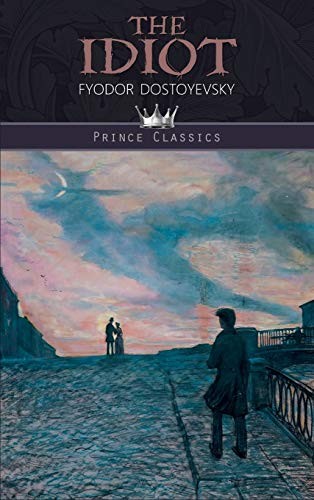
The Idiot
Fyodor Dostoevsky · 1821–1881 · Russia
Originally The Idiot (Russian)
Why it matters
Dostoevsky's experiment: set a 'perfectly beautiful man' loose in society and watch the world destroy him. Prince Myshkin's goodness proves as catastrophic as any vice: the novel's most heartbreaking thought experiment.
At a glance
Sprawling cast, digressive scenes of hysteria, and a deliberately unstable narrative center.
Deep dive
Dostoevsky drops a genuinely good, guileless man into Petersburg high society to see what happens to real innocence once money, vanity, and two competing claims on the same woman get hold of it.
Written for readers who have finished the book. No plot recap, and nothing here is safe to read first.
Themes & symbolism
Prince Myshkin returns to Russia from a Swiss sanatorium, cured enough of his epilepsy to function but still radically unfit for the social calculation everyone around him takes for granted, and Dostoevsky means that unfitness as the whole experiment: what does a person who is simply, straightforwardly honest, incapable of strategy or self-interest, actually do inside a world built entirely on both? Myshkin isn't naive in the way that word usually implies; he sees other people's motives with unsettling clarity, he just refuses, on principle, to use what he sees against them, and that refusal reads to Petersburg society as either idiocy or a threat, often both at once.
Nastasya Filippovna, kept as a rich man's mistress since adolescence and treated by nearly everyone, including the men competing to marry her, as damaged property rather than a person, is the character Dostoevsky uses to test whether Myshkin's compassion can actually survive contact with a woman shaped entirely by other people's cruelty. Rogozhin, his rival, offers her raw, possessive passion rather than Myshkin's disinterested pity, and Nastasya's oscillation between the two men reads less like indecision than like someone testing which kind of attention will destroy her fastest, having concluded, with some justice, that no version of love on offer will let her keep any dignity.
Epilepsy as Both Affliction and Aura
Dostoevsky gives Myshkin his own epilepsy, including the transcendent aura some epileptics report just before a seizure, a few seconds of total harmony and certainty that Myshkin describes as worth years of ordinary life, weighed against the illness's cost in social credibility and physical collapse. That doubled portrait, a condition that is simultaneously a genuine spiritual gift and a practical catastrophe, keeps the novel from treating Myshkin's goodness as costless; his clearest moments of insight and his most damaging public breakdowns come from exactly the same source.
The Christ Figure Dostoevsky Wasn't Sure Would Survive Russia
Dostoevsky described his ambition in letters as portraying 'a positively good and beautiful man,' explicitly modeled in part on Christ and Don Quixote, and worried openly, while writing, whether such a figure could be made believable at all rather than merely pathetic. He tested Myshkin against Petersburg's most concrete, unglamorous form of corruption, inheritance disputes, marriage as a financial transaction, gossip as social currency, rather than any grand villain, because he wanted to know whether pure goodness could survive ordinary greed, not just spectacular evil.
The last seal: what actually happens, and why it lands the way it does.
The ending, explained
Nastasya Filippovna finally chooses Myshkin at the altar, then flees the wedding at the last moment to go to Rogozhin instead, unable to believe she deserves the calm, undemanding devotion Myshkin offers and drawn instead to the consuming intensity she already half expects will destroy her. Myshkin follows the two of them to Rogozhin's house days later and finds Rogozhin has taken her life, her body laid out under a sheet in a room the two men then sit beside together through the night, Myshkin comforting his rival rather than recoiling from him. The strain of it, arriving after months of social exposure and a broken engagement, finally overwhelms Myshkin's fragile stability altogether: he lapses back into the total incapacity his epilepsy had always threatened, and the novel closes with him returned to the Swiss sanatorium, permanently unreachable, Dostoevsky's bleakest verdict on how much goodness Russian society will actually let a person keep.
Where to go next
 Fyodor Dostoevsky · 1864Notes from UndergroundLvl 7Slow burn
 Fyodor Dostoevsky · 1866Crime and PunishmentLvl 6Fast paced
 Fyodor Dostoevsky · 1867The GamblerLvl 4Fast paced
 Fyodor Dostoevsky · 1872DemonsLvl 8Medium pace
 Fyodor Dostoevsky · 1880The Brothers KaramazovLvl 8Slow burn
 Nikolai Gogol · 1842Dead SoulsLvl 5Medium pace