
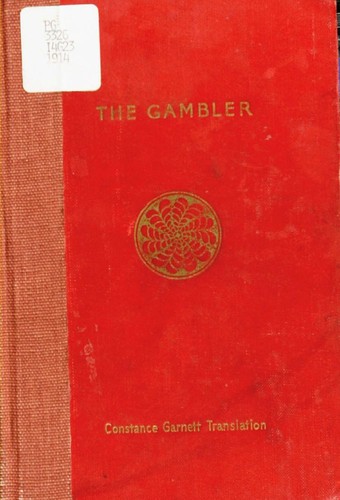
The Gambler
Fyodor Dostoevsky · 1821–1881 · Russia
Originally Igrok (Russian)
Why it matters
Dictated in under a month to a stenographer to outrun a punishing contract deadline, Dostoevsky's own roulette addiction becomes a young tutor's spiral at the wheel in a German spa town. The compulsion that nearly ruined its author supplies fiction's sharpest study of addiction as its own kind of faith.
At a glance
Short and fast-moving, though its narrator's obsessive spiraling logic takes some patience.
Deep dive
Dostoevsky wrote this one in twenty-six days flat to beat a contract deadline designed to bankrupt him, dictating to a stenographer he would marry within the year, and its portrait of addiction reads less like invention than confession.
Written for readers who have finished the book. No plot recap, and nothing here is safe to read first.
Themes & symbolism
Alexei Ivanovich tutors the children of a debt-ridden Russian General in the fictional spa town of Roulettenburg, in love with the General's stepdaughter Polina and increasingly convinced that a single decisive act, one enormous win at the roulette table, could resolve both his finances and his standing with her. Dostoevsky builds the entire cast around the same fantasy of a fortune arriving from outside: the General is waiting on the death of his wealthy aunt in Moscow to pay off Mlle Blanche, the Frenchwoman he hopes to marry, while Polina is quietly indebted to the oily De Griers and needs money of her own to be free of him. Nobody in the novel is capable of simply working or waiting; everyone is fixated on a windfall.
That fixation gets its cruelest joke when the aunt, Antonida Vasilyevna, arrives from Moscow not dead but very much alive, wheels herself to the roulette table, and loses a staggering sum of the family's expected inheritance in a single reckless afternoon, destroying the General's plans by demonstrating exactly the compulsion he was counting on her to avoid. Alexei later wins an even larger fortune himself, but Dostoevsky refuses the money any redemptive power: when Alexei brings it to Polina as proof of what he'll do for her, she throws it back in his face, having already accepted a payoff from De Griers and reading Alexei's win as one more transaction rather than the declaration of love he intended it to be.
A Novel Written Against a Deadline
Dostoevsky's publisher Stellovsky had locked him into a contract stipulating that if he failed to deliver a new novel by November 1, 1866, Stellovsky would acquire the rights to everything Dostoevsky had ever written or would write for the next nine years, without payment. With a month left and no manuscript, Dostoevsky hired a young stenographer, Anna Grigorievna Snitkina, dictated The Gambler to her in twenty-six days, and delivered it on time. Dostoevsky married Anna the following February. The novel's fluent understanding of a gambler's self-deceptions, each loss reframed as one bet away from the system finally working, was not researched: Dostoevsky had been a compulsive roulette player himself for years, losing money he and Anna badly needed on the same German spa circuit the novel is set in, a habit Anna's own diaries record him finally breaking only after several more disastrous trips abroad.
The last seal: what actually happens, and why it lands the way it does.
The ending, explained
After Polina rejects his winnings, Alexei drifts into exactly the pattern the novel has spent its length diagnosing: he leaves for Paris, briefly enjoys the trappings of wealth with Mlle Blanche before she abandons him once the money runs low, and ends up years later, by his own account, moving from gambling town to gambling town, still certain that one more well-timed bet will restore everything he's lost, Polina included. Dostoevsky denies him any dramatic collapse or crisis; the last chapter is simply Alexei rationalizing to himself, still inside the fantasy the novel opened with, evidence that the addiction was never a problem to be solved by a single win or loss but a permanent way of relating to hope itself.
Where to go next
 Fyodor Dostoevsky · 1864Notes from UndergroundLvl 7Slow burn
 Fyodor Dostoevsky · 1866Crime and PunishmentLvl 6Fast paced
 Fyodor Dostoevsky · 1869The IdiotLvl 7Slow burn
 Fyodor Dostoevsky · 1872DemonsLvl 8Medium pace
 Fyodor Dostoevsky · 1880The Brothers KaramazovLvl 8Slow burn
 Nikolai Gogol · 1842Dead SoulsLvl 5Medium pace