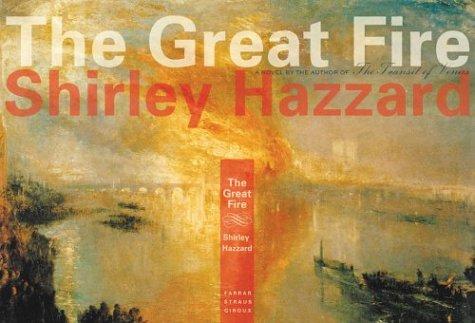
The Great Fire
Shirley Hazzard · 1931–2016 · Australia
Why it matters
A decorated British officer surveys occupied postwar Japan's wreckage and falls, slowly and formally, for a young Australian woman living in Hiroshima's long shadow. Hazzard's National Book Award winner is devastation and restraint held in the same exact sentence.
At a glance
Formal, exacting prose and understated emotion ask for close, patient reading.
Deep dive
Why a war correspondent's account of firebombed Japan keeps circling back to a love affair, and why the occupation force policing his romance just finished burning entire cities.
Written for readers who have finished the book. No plot recap, and nothing here is safe to read first.
Themes & symbolism
Hazzard sends Aldred Leith to occupied Japan in 1947 to document the aftermath of the incendiary raids that gutted Tokyo in a single night, the most destructive bombing raid of the war, and the title's fire refuses to stay contained to that assignment. It migrates to Leith's own history, a decorated infantry command in Europe, an unfinished book, a father he has never managed to love easily, and finally to Helen Driscoll, the seventeen-year-old he falls for inside the compound where her father runs an occupation post. The two fires, the one that leveled cities and the one that levels a thirty-two-year-old man's careful self-possession, are meant to sit on the same page and force a comparison the characters around them mostly refuse to make.
That refusal belongs chiefly to the Driscolls, whose scandal at their daughter's attachment to an older man reads, next to their near-indifference to their son Ben's decline, as a thoroughly inverted moral scale. Ben, dying slowly of an inherited nerve disease, is the household's most alert intelligence and its least protected member, and his parents manage his illness the way they manage the furniture while reserving their real outrage for Helen wanting something of her own. An empire that has just finished incinerating civilian cities in the name of necessity still finds ample energy left over to police a girl's heart.
Peter Exley, Leith's friend prosecuting war crimes out of Hong Kong, supplies the counter-example. He has trained himself, through tribunal work and a string of declined attachments, into a careful paralysis: expert at documenting other men's atrocities, incapable of risking exposure of his own. Leith's willingness to want Helen openly, against advice and against his own history of guarded engagements, is what the novel ultimately holds up as the harder, more honest use of a life spent surviving a war.
The Occupation's Small World
Kure, where Leith is billeted, is Allied Japan reduced to a garrison town: mess dinners, postings gossip, a hierarchy of rank reproduced among the civilians attached to it. Hazzard keeps the physical evidence of the firebombing and the atomic attack at the edges of the frame, glimpsed rather than toured, because her real subject is what happens to the occupiers rather than a survey of the suffering they have been sent to administer. The compound's manners, its dinner parties and reputations, read as almost willfully small against what surrounds them, and that smallness is the point: catastrophe on this scale does not automatically produce proportionate people.
The last seal: what actually happens, and why it lands the way it does.
The ending, explained
Ben dies before the novel's final movements, freeing Helen from the caretaking that has defined her adolescence and removing the one Driscoll whose objections to Aldred were never really about propriety. Her parents, still opposed, take a posting to New Zealand explicitly to put an ocean between her and Leith. Aldred, meanwhile, returns to England for his own father's death, a duty that keeps him from Helen for months and echoes, in a minor key, the war's habit of holding people apart through obligation rather than choice. With both fathers gone and nothing left to manage, Leith finally has nothing standing between him and the decision he has spent the book approaching sideways, and the closing pages send him toward New Zealand and toward her, the fire, at last, burning down into something usable rather than annihilating.