
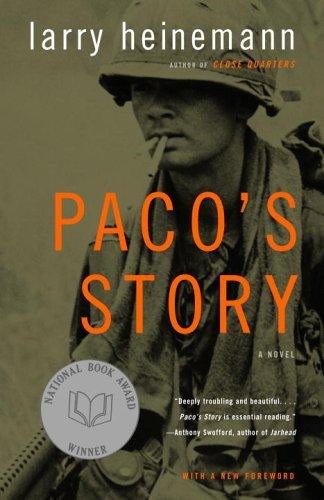
Paco's Story
Larry Heinemann · 1944–2019 · United States
Why it matters
The ghosts of an entire dead infantry platoon narrate their sole survivor's numb, disbelieving return to small-town America. Heinemann's National Book Award winner, an upset over Beloved, refuses Vietnam's violence any comforting distance.
At a glance
An unusual collective ghost narrator and flat, unsentimental violence demand close attention.
Deep dive
Told entirely by the dead men of Paco's own platoon — because the living, it turns out, were never going to be able to hear this from him directly.
Written for readers who have finished the book. No plot recap, and nothing here is safe to read first.
Themes & symbolism
Heinemann's decision to narrate through the collective "we" of Alpha Company's dead — soldiers killed alongside Paco at Fire Base Harriette, watching over him now that he's the sole survivor — solves the problem the novel is actually about: the impossibility of communicating combat trauma to anyone who wasn't there. Paco physically cannot tell his own story in language that would land with the civilians around him; only the dead, freed from a living listener's patience or self-protection, can narrate the events at Harriette in the graphic, unsentimental detail Heinemann insists on rather than softens.
The scene of Cathy, a local teenager, reading Paco's diary and studying his body through a window turns his own privacy and scarred flesh into spectacle, deliberate or not — the domestic, peacetime mirror of the war's violence toward bodies, now performed by curiosity rather than combat. Boone offers Paco physical safety, a job, a room, but no real community; that peace is its own form of exile, and the town's collective inability to actually receive what happened to him is the point the ghost-narrators exist to make unmissable.
Heinemann's prose refuses the reader the usual comforts of war-novel language — no elevated diction, no tidy metaphor standing in for horror at a safe remove. The dishwashing job Paco takes, scrubbing pots in a diner's back kitchen for a boss who barely registers him as a person, restages the war's basic indignity in miniature: a body used for labor nobody thanks him for, in a country that fought the war mostly by not thinking about it, then and afterward both.
A War Novel That Refuses Catharsis
Heinemann served in Vietnam and wrote against the redemptive arc common to the genre's earlier entries — there is no lesson learned, no community that rises to meet Paco, no scene of healing. The prose stays matter-of-fact and unmoralized even in its most brutal passages, a deliberate refusal to let the reader feel that witnessing the violence has purchased any insight or absolution. The novel's 1987 National Book Award win, controversially awarded over Toni Morrison's Beloved, remains part of its reception history and a frequent point of critical argument about how American literary culture chose to reckon with Vietnam versus slavery in the same decade.
The last seal: what actually happens, and why it lands the way it does.
The ending, explained
Paco's tentative, wordless connection with Cathy never develops into anything — she remains as unable to truly see him as everyone else in Boone, and the possibility of the town becoming an actual home for him quietly closes. He leaves anonymously, hitchhiking on to nowhere in particular, exactly as he arrived. Nothing is resolved because Heinemann refuses the resolution: Paco's story is handed back to the ghosts who have been carrying it all along, since the living around him, despite proximity and even goodwill, never really received it.
Where to go next
 Bảo Ninh · 1990The Sorrow of WarLvl 6Slow burn
 António Lobo Antunes · 1979The Land at the End of the WorldLvl 8Slow burn
 Norman Mailer · 1948The Naked and the DeadLvl 6Fast paced
 Anne Michaels · 1996Fugitive PiecesLvl 7Slow burn
 Jaimy Gordon · 2010Lord of MisruleLvl 6Slow burn
 Richard Ford · 1995Independence DayLvl 6Slow burn