
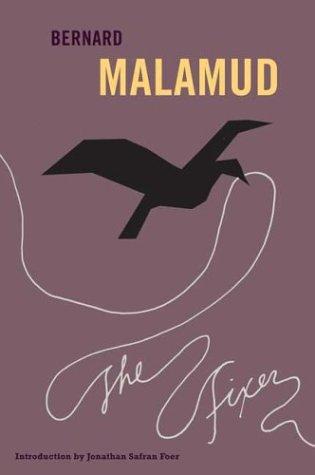
The Fixer
Bernard Malamud · 1914–1986 · United States
Why it matters
A Jewish handyman in czarist Russia is imprisoned on a false blood-libel charge and endures years of degradation without confessing. Malamud's Pulitzer-winning parable of injustice and endurance.
At a glance
Claustrophobic close narration sustained across an extended imprisonment.
Deep dive
Why Malamud ends the novel before the verdict, and what a jailed handyman gets out of reading Spinoza between interrogations.
Written for readers who have finished the book. No plot recap, and nothing here is safe to read first.
Themes & symbolism
Yakov Bok's trade gives the novel its cruelest irony: a man who earns his living repairing other people's broken carts and roofs is himself unfixable within a system that has already decided, before any evidence, what he is for. The blood-libel charge against him — that he murdered a Christian boy to use his blood in matzah — revives a medieval accusation the Russian state needs regardless of facts, and Malamud renders the machinery of that need in flat, procedural detail: cell searches for hidden poison, forced confessions dangled and withdrawn, the prosecutor Grubeshov's genial, bureaucratic antisemitism. Bok carries a copy of Spinoza's Ethics into this machinery and reads it as a survival manual, testing whether a mind can remain free while a body is held in total unfreedom.
Malamud grounds the plot in the real 1911–13 Beilis case in Kiev, but the novel's ambition is to universalize it: Bok begins the book trying to erase his own Jewishness, living under a false identity in a district forbidden to Jews, and his ordeal strips that evasion away entirely, leaving him unable to imagine himself as anything but what his captors have named him. The transformation completes itself off the page of any single scene and instead across the accumulation of small refusals — he will not confess to a crime he did not commit, will not implicate other Jews to save himself — until refusal becomes the one form of freedom prison cannot search him for.
The Beilis Case Behind the Novel
Malamud drew directly on the trial of Mendel Beilis, a Kiev Jew accused of ritual murder in 1911 and acquitted at trial in 1913 after two years' imprisonment — but the novel deliberately withholds that historical outcome from its own fictional Bok, closing before any verdict is rendered. The omission is a formal choice, not a cliffhanger: Malamud wants the injustice left open on the page, unresolved by acquittal or conviction, so the reader sits with the ordeal itself rather than the relief of a happy ending borrowed from history.
Raisl's Child and Chosen Paternity
Bok's estranged wife Raisl returns pregnant by another man, and Bok, facing his own trial, agrees to claim her son Chaim as his own rather than let the boy be raised in shame — an act of paternity chosen rather than biological, extended to a stranger's child by a man with every reason to refuse it. It echoes the novel's Spinozist argument in miniature: freedom isn't the absence of constraint but what a person does with the narrow room constraint leaves them.
The last seal: what actually happens, and why it lands the way it does.
The ending, explained
After more than two years' imprisonment without formal trial, Bok is finally loaded into a carriage and driven through Kiev toward the courthouse, hostile crowds lining the streets. He imagines, unbidden, firing a pistol at the passing Tsar, and arrives at the thought that closes the novel: there is no such thing as an unpolitical man, especially not a Jew. Malamud stops there, deliberately declining to show the trial or its verdict — the point isn't suspense but transformation. The man who began the book trying to disappear into neutrality ends it incapable of that evasion any longer, forged by the ordeal into someone who has to act, whatever the courtroom eventually decides.
Where to go next
 Bernard Malamud · 1957The AssistantLvl 5Slow burn
 Bernard Malamud · 1958The Magic BarrelLvl 5Medium pace
 Isaac Bashevis Singer · 1960The Magician of LublinLvl 5Medium pace
 Philip Roth · 1969Portnoy's ComplaintLvl 5Fast paced
 Norman Mailer · 1948The Naked and the DeadLvl 6Fast paced
 Saul Bellow · 1964HerzogLvl 7Slow burn