
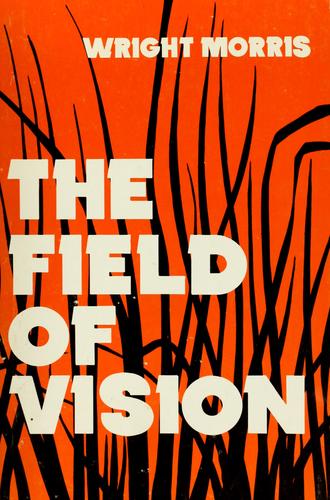
The Field of Vision
Wright Morris · 1910–1998 · United States
Why it matters
Five people from one Nebraska family watch a Mexico City bullfight, each one's private memory reopening the same buried disappointments and betrayals. Morris's first National Book Award winner turns a single afternoon into a prism for an entire American past.
At a glance
Shifting close-third perspectives circle the same hour from five angles at once.
Deep dive
Five people watch the same bullfight from the same seats in Mexico City, and Wright Morris spends the entire novel proving that none of them, including two who once loved each other, are really watching the same afternoon at all.
Written for readers who have finished the book. No plot recap, and nothing here is safe to read first.
Themes & symbolism
The Field of Vision unfolds over a single afternoon at a bullfight, where Walter McKee, his wife Lois, their young grandson, Lois's blind and deaf father Tom Scanlon, and, by pure coincidence, Walter's childhood friend Gordon Boyd, find themselves seated together. Morris structures the novel by rotating narration among all five, plus a psychoanalyst, Dr. Lehmann, seated nearby, each chapter written in a close third person tuned to that character's own private preoccupations, so that the shared external event, men, capes, a bull, barely registers as the same event from one consciousness to the next.
Boyd's unexpected appearance forces the novel's real subject into view: decades earlier, in their small Nebraska hometown, Boyd and Lois were drawn to each other before Lois married the steadier, less imaginative Walter instead, and Morris uses the accident of their reunion at ringside to measure how completely each of them has spent the intervening years narrating that choice to themselves differently, Lois as a life of quiet, unacknowledged regret, Walter as a settled contentment he's not entirely sure he actually feels, Boyd as a series of failed reinventions he can't stop blaming on the moment he lost her.
The Bullfight as a Passive Mirror
Morris keeps the actual bullfight almost entirely offstage, glimpsed only in fragments each character barely registers, which is itself the point: none of the five people at ringside are really watching the bull. The spectacle everyone paid to see becomes a blank surface each consciousness projects its own unfinished history onto, Morris's structural argument that perception is never simply receptive, it is always already occupied by whatever a person brought with them.
Tom Scanlon's Silence as a Warning
Lois's father, blind, deaf, and long expected to die, sits at the novel's edge as a portrait of where unexamined passivity eventually leads: a man who spent his own life narrating himself into inaction has ended up literally cut off from the world he once declined to fully enter. Morris positions Scanlon as the fate Boyd is still, barely, in time to avoid, which gives the afternoon's small rescue more weight than its size would otherwise suggest.
The last seal: what actually happens, and why it lands the way it does.
The ending, explained
Late in the bullfight, Boyd impulsively throws the sleeping grandson's coonskin cap into the ring, and when the boy bolts after it in danger of the animal, Boyd's own paralysis breaks: he moves to pull the child back to safety, an unplanned, unheroic, entirely physical act that becomes the only real event in a novel otherwise built from memory and interior monologue. Morris frames the rescue as Boyd's quiet turning point, not a dramatic redemption but a small, concrete refusal of the drifting passivity that has defined his adult life, a decision, finally, to act rather than keep narrating himself as someone who once might have acted differently. The novel ends without resolving Lois and Boyd's old attachment or granting Walter any confrontation he doesn't already know how to avoid; the coonskin cap, retrieved, is the closest thing to a plot the afternoon ever produces, and Morris treats that smallness as the honest measure of most people's actual capacity for change.
Where to go next
 Wright Morris · 1980Plains Song: For Female VoicesLvl 5Slow burn
 William Maxwell · 1979So Long, See You TomorrowLvl 5Slow burn
 Peter Taylor · 1986A Summons to MemphisLvl 5Slow burn
 Carol Shields · 1993The Stone DiariesLvl 5Medium pace
 Jaimy Gordon · 2010Lord of MisruleLvl 6Slow burn
 John Casey · 1989SpartinaLvl 4Medium pace