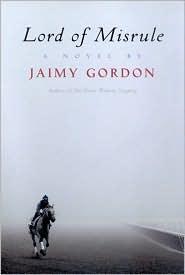
Lord of Misrule
Jaimy Gordon · b. 1944 · United States
Why it matters
A claiming-race horse and the grooms, trainers, and gamblers scraping by around him circle a rundown West Virginia track across four unglamorous races. Gordon's dense, dialect-rich novel, published by a tiny press, won the National Book Award in a stunning upset.
At a glance
Thick racetrack dialect and shifting close-third perspectives take some acclimating.
Deep dive
Why a cheap-track scheme to run four undervalued horses at a bottom-rung West Virginia track and skip town with the winnings ends up mattering less to Jaimy Gordon's novel than the backstretch grooms and loan sharks who keep the whole crooked economy running underneath it.
Written for readers who have finished the book. No plot recap, and nothing here is safe to read first.
Themes & symbolism
Tommy Hansel's plan, to enter four horses that look worse on paper than they run and cash out before Indian Mound Downs catches on, sets him up as the novel's obvious protagonist, but Gordon keeps handing the book's actual attention to Medicine Ed, a groom in his seventies who has spent a working life rubbing other men's horses for other men's money. Long stretches of the novel run in close free indirect style tuned to Ed's own cadence and diction, and that redistribution of narrative weight is the argument: ownership at Indian Mound Downs lasts exactly as long as a claiming tag, but the labor of feeding, walking, and doctoring a horse belongs, hour by hour, to the people the grandstand never looks at.
The horse the title names, a faded stakes campaigner now running out his last soundness at the bottom of the class ladder, carries the book's central joke doubled over on itself: Lord of Misrule is also the name given, in old English festival custom, to whoever gets crowned king of a single day of licensed chaos before being deposed without ceremony. Gordon applies that logic to everyone circling the track, Tommy's few weeks of ownership, Joe Dale Bigg's brief reign of intimidation over Maggie and every groom who owes him money, even Two-Tie's underworld authority, and lets the novel's backstretch regulars watch each reign collapse with the weary patience of people who have already seen the pattern run a hundred times.
Medicine Ed's Backstretch English
Gordon spent years working the racing circuit before writing the novel, and it shows most clearly in how precisely Ed's interior voice is tuned, his superstitions about luck and money, his private ledger of which owners and trainers can be trusted, rendered without a trace of condescension or dialect-as-costume. Giving a Black groom in his seventies more interior real estate than the novel's ostensible white protagonist was, in 2010, still an unusual structural choice for a prize novel about American gambling, and it is exactly what lets Lord of Misrule read as a labor novel wearing a caper's clothes.
What the Track Does to Bodies
Gordon writes the horses' injuries in the same unsentimental register she gives the humans': bowed tendons, joints run past soundness, the blacksmith Kidstuff patching hooves that should have been retired seasons earlier. The cruelty isn't staged as a single villain's doing but as the ordinary output of an economy that needs cheap, expendable bodies, equine and human both, to keep generating purses for people who never touch the dirt.
The last seal: what actually happens, and why it lands the way it does.
The ending, explained
Joe Dale Bigg has fixed the last race to guarantee a win for his own horse, the aging Lord of Misrule, covering the bets he has forced onto half the backside. During the race another horse, Mahdi, collides with Lord of Misrule, taking them both out of contention and leaving Pelter, the least regarded of Tommy's four entries, to win instead. Medicine Ed and his fellow groom Deucey, who had quietly defied Joe Dale by betting on Tommy's other horse, Little Spinoza, collect enough from the unexpected result to plan their own quiet escape from Indian Mound Downs before Joe Dale can make them answer for it. Gordon closes not on Tommy, whose scheme dissolves along with his nerve, but on Ed and Maggie, still standing in the backstretch dirt: the con is over, but the economy that made it necessary closes back over the track exactly as it was.