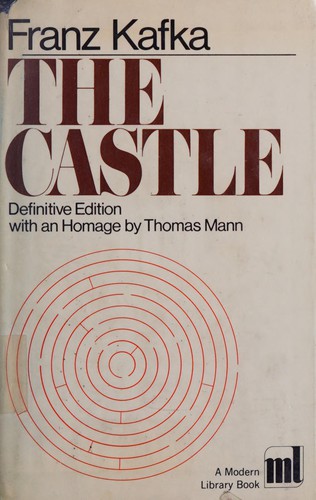
The Castle
Franz Kafka · 1883–1924 · Czechia (Bohemia)
Originally Das Schloss (German)
Why it matters
A land surveyor arrives in a village to serve a Castle that never admits him: striving as a condition, arrival as a mirage. Unfinished, like its hero's errand; the bleakest and funniest of Kafka's three novels.
At a glance
Long, circular paragraphs and an unresolved, unfinished plot deliberately deny closure.
Deep dive
A land surveyor arrives in a village at the foot of a castle that summoned him, and spends the rest of the book, and the rest of Kafka's life, failing to get any closer to it than the inn he started in.
Written for readers who have finished the book. No plot recap, and nothing here is safe to read first.
Themes & symbolism
K. arrives claiming an appointment as land surveyor for the Castle authorities, and the entire novel turns on the fact that this claim is never confirmed and never quite denied. The Castle's officials communicate only through a haze of contradictory memos, unreliable messengers, and a telephone exchange that produces sound with no meaning behind it, and Kafka builds an entire cosmology out of the gap between K.'s conviction that he has a right to be heard and the village's flat certainty that access to the Castle simply isn't a thing that happens to people like him. Klamm, the official K. becomes obsessed with reaching, is glimpsed exactly once, through a peephole, and never speaks to him directly in the whole book.
The Barnabas family carries the novel's one real story of consequence: the daughter Amalia is ostracized by the entire village, and her family financially ruined, after she tears up an obscene note propositioning her from the official Sortini, an act of refusal nobody around her can even process as reasonable, since refusing an official, however crudely he behaves, reads to the village as a kind of blasphemy. Frieda, Klamm's former mistress and briefly K.'s lover, represents the opposite path, proximity to power traded for a kind of secondhand status, and Kafka lets the contrast between Amalia's ruin and Frieda's compromised access stand as the book's real argument about what it costs to either refuse the Castle or court it.
Two Assistants Nobody Can Tell Apart
K. is assigned two assistants, Artur and Jeremias, whom he can never distinguish from each other and treats as functionally the same person throughout, a running joke that is also a small thesis statement: the Castle's bureaucracy does not deal in individuals, only in interchangeable functions, and even the men sent to help K. arrive already stripped of the specificity he is fighting the whole system to be granted.
The last seal: what actually happens, and why it lands the way it does.
The ending, explained
Kafka stopped writing mid-sentence, in the middle of a conversation between K. and a landlady, and the manuscript simply ends there, unrevised and untitled by chapter for its last stretch. Max Brod, who published it against Kafka's wishes, reported that Kafka had described the intended ending to him in conversation: K. was to die still shut out of the Castle, exhausted by the pursuit, at which point word would arrive that although his claim to the surveyor post had never been valid, he would nonetheless be permitted, taking certain circumstances into account, to go on living in the village. The permission was always going to come, in other words, and it was never going to matter, a shape so consistent with the six hundred finished pages that the novel's incompleteness reads less like an accident than like Kafka's actual subject overtaking his ability to finish narrating it.