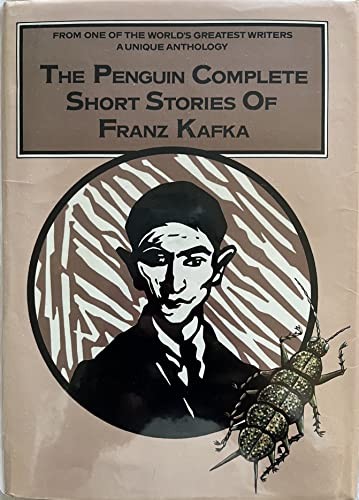
The Complete Stories
Franz Kafka · 1883–1924 · Czechia (Bohemia)
Originally The Complete Stories (German)
Why it matters
'In the Penal Colony,' 'A Hunger Artist,' 'The Judgment': the shorter fiction where Kafka perfected the nightmare logic his novels only had room to sustain. Everything the adjective 'Kafkaesque' actually describes started here.
At a glance
Individual pieces range from brief parables to dense fragments, uneven in demand story to story.
Deep dive
The shorter fiction where a starving performer, a father's verdict, and a penal colony's machine all run on the same airtight, unappealable logic that the word 'Kafkaesque' was coined to describe.
Written for readers who have finished the book. No plot recap, and nothing here is safe to read first.
Themes & symbolism
'The Judgment', which Kafka wrote in a single overnight sitting in 1912 and considered the moment he found his own method, ends with an old, supposedly failing father rising from his sickbed to condemn his son Georg to death by drowning, a sentence Georg carries out on himself immediately and without visible protest. The logic that makes obedience to an unjust verdict feel inevitable rather than absurd, inside the story, is the mechanism Kafka would spend the rest of his short career refining.
'In the Penal Colony' externalizes that same logic into an actual machine: a device that executes condemned men by inscribing their sentence directly into their skin over twelve hours, defended by an officer who loves the apparatus more than he questions its verdicts. When the machine finally breaks down on the one occasion the officer submits himself to it, Kafka lets obsolescence, not moral awakening, end the old order. 'A Hunger Artist' runs the same structure toward pathos instead of horror: a professional faster starves himself for an audience that first admires, then forgets, then finally replaces him in his own cage with a panther whose plain animal appetite the crowd finds more honest than his art.
The Judgment as Kafka's Overnight Discovery
Kafka wrote 'The Judgment' between the evening of September 22 and the early morning of September 23, 1912, and later called the experience of writing straight through the night 'the complete opening of body and soul.' He dedicated it to Felice Bauer, whom he had met weeks earlier, and biographers generally treat the story as the hinge where his mature voice, unexplained authority, disproportionate punishment, a protagonist who complies, arrives fully formed rather than developing gradually across earlier work.
A Panther Replaces the Art
The hunger artist's decline is measured entirely in shrinking audiences and a manager who eventually stops bothering to update the little sign counting his fasting days, so that when he finally admits, dying, that he only ever starved because he never found food he liked, the confession lands as anticlimax rather than revelation. The panther that takes over his cage draws bigger crowds purely by eating with visible pleasure, and Kafka lets that substitution stand as the whole verdict on what audiences actually want from suffering they're asked to watch.