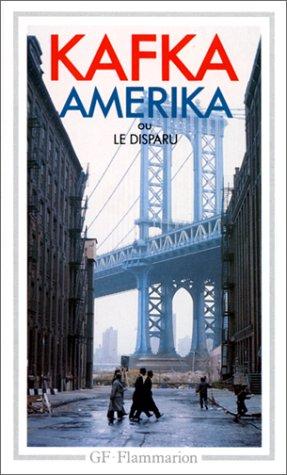
Amerika
Franz Kafka · 1883–1924 · Czechia (Bohemia)
Originally Der Verschollene (German)
Why it matters
Sixteen-year-old Karl Rossmann is shipped off to an America he can't parse, drifting through absurd hierarchies of hotels, offices, and an open-air theater that may hire everyone alive. Kafka's unfinished first novel, oddly his most hopeful: nothing here has caught up with its hero yet.
At a glance
Episodic and unfinished, but its individual scenes read more plainly than Kafka's other novels.
Deep dive
A sixteen-year-old is shipped off to America after a scandal involving the family maid, and Kafka, in the one novel he wrote with something close to affection for his hero, sends him through an escalating series of American institutions each more arbitrary than the last.
Written for readers who have finished the book. No plot recap, and nothing here is safe to read first.
Themes & symbolism
Karl Rossmann's crime, seduced by the family servant Johanna Brummer, who then has his child, is framed by Kafka as barely his fault at all, an unusual softness for a writer who elsewhere refuses his protagonists any innocence worth defending. That softness carries through the whole book: Karl is repeatedly punished by institutions, a rich uncle who disowns him after one unauthorized visit, a hotel that fires him for a few minutes' absence from his post as elevator operator, without ever having done anything to deserve it, and Kafka's satire lands less on Karl than on an America that promises boundless reinvention while running on the identical arbitrary authority he might have fled Europe to escape.
The novel's back half strands Karl with two con men, Robinson and Delamarche, who use him first as a servant and finally as an unpaid attendant to Delamarche's mistress, the grotesque, bedridden singer Brunelda, in an apartment Karl can barely leave. Kafka lets American abundance curdle into exactly the kind of trap his European fiction builds out of bureaucracy: Karl's problem was never scarcity, it was that every open door in the novel turns out to be a mechanism for closing behind him, and each new patron who offers him shelter, the uncle, the hotel, Delamarche, turns out to run a household with rules as arbitrary and unappealable as any court.
A Statue of Liberty Holding a Sword
The novel's opening line famously describes the Statue of Liberty holding aloft a sword rather than a torch, a detail scholars have never fully settled as either a deliberate distortion or a simple error by a writer who never crossed the Atlantic and worked entirely from other people's accounts and photographs. Either way it sets the tone precisely: Kafka's America is recognizable enough to be believed and subtly wrong enough to unsettle, a New World built out of the same institutional menace as the Old, its most famous symbol of welcome quietly rearmed as a symbol of judgment before the story has even begun.
The last seal: what actually happens, and why it lands the way it does.
The ending, explained
The surviving manuscript breaks off with Karl answering a surreal open call for the Nature Theatre of Oklahoma, a company that promises to employ absolutely everyone regardless of qualification, boarding a train west under a new stage name. Max Brod reported that Kafka, unusually for him, spoke of the planned ending with something like amusement rather than dread: Karl's fortunes in the Nature Theatre were to turn, and the fragment was to close on a note of what Brod called reconciliation, Karl finding something resembling a home and a profession after every other institution in the book had expelled him. Kafka never wrote that far, but the shift in tone is already audible in the fragment's own eerie, carnival-like optimism, the one time in his fiction that an infinite bureaucratic apparatus is dangled as a possible rescue rather than only ever a trap.