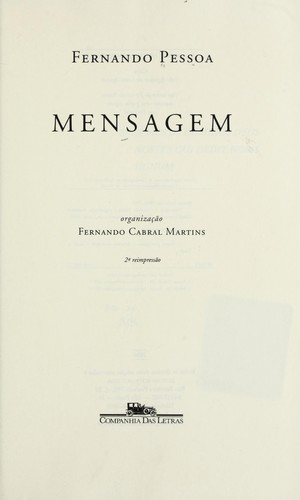
Message
Fernando Pessoa · 1888–1935 · Portugal
Originally Mensagem (Portuguese)
Why it matters
Pessoa's only Portuguese-published book in his lifetime: forty-four poems recasting Portugal's age of maritime discovery as a still-unfinished national myth, written under his own name rather than a heteronym's. His single most concentrated bid for a poetry of destiny.
At a glance
Dense, symbol-laden verse steeped in Portuguese history and myth, demanding close, deliberate reading.
Deep dive
How a slender book of verse turns a coat of arms, the Atlantic, and a king who vanished on a Moroccan battlefield into a single argument about Portugal's unfinished destiny.
Written for readers who have finished the book. No plot recap, and nothing here is safe to read first.
Themes & symbolism
Pessoa builds Mensagem as a blazon: the book's first part, Brasão, assigns each of Portugal's mythic and historical founders, Ulysses credited with naming Lisbon, the Roman-resisting warrior Viriathus, the first king Afonso Henriques, the navigator Vasco da Gama, to a specific field or charge on the national coat of arms, so that reading the sequence in order is literally reading the shield left to right, top to bottom. History becomes heraldry, and heraldry becomes a claim: that everything Portugal did on the Atlantic was already latent in the shape of its own crest.
The second part, Mar Português, turns from blazon to reckoning. Its best-known poem opens by asking whether the salt in the sea's water is made of Portugal's tears, and answers that every mile the caravels sailed cost a mother her son, a wife her husband, a child his father, before insisting the price was worth paying if the soul behind it was not small. Pessoa does not romanticize the Discoveries so much as put a ledger under them, grief entered on one side, greatness claimed on the other, and lets the poem hold both without resolving which outweighs which.
The third part, O Encoberto, drops history for prophecy. It rebuilds the Sebastianist myth, the belief that King Sebastião, lost at Alcácer Quibir in 1578 leading an invasion of Morocco, never actually died and will return on a misty morning to restore Portugal, into something closer to a spiritual argument than a royalist one: the Hidden One Pessoa invokes is less a specific Habsburg-era monarch than a name for a Fifth Empire still owed to Portuguese culture, an age of the spirit rather than of conquest.
The Only Book Pessoa Signed With His Own Name
Nearly everything else Pessoa wrote in Portuguese he assigned to invented poets with their own biographies and styles, the pastoral fatalist Alberto Caeiro, the classicist Ricardo Reis, the futurist engineer Álvaro de Campos, keeping his own name mostly for criticism and correspondence. Mensagem, published in 1934 and awarded a prize by the Secretariado de Propaganda Nacional, the regime cultural office under António de Oliveira Salazar, was the sole book he issued under his own name in his lifetime; he died the following year, so this is the one place Pessoa let his own signature stand behind a vision of the country rather than behind an invented poet's.
A Fifth Empire the Regime Misread
Salazar's Estado Novo prized the book for its imperial nostalgia and folded it into its own propaganda about Portugal's civilizing mission, but Pessoa's Fifth Empire was never a program for holding onto colonies. Reis and Caeiro's creator wanted a Portugal that led the world in spirit and culture the way it once led it in ships, a mystical nationalism closer to prophecy than policy, and the prize committee that honored Mensagem was reading past the very ambiguity that makes O Encoberto's king a symbol nobody, then or now, can fully cash out into a political platform.