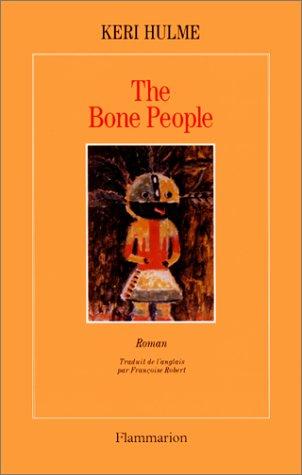
The Bone People
Keri Hulme · 1947–2021 · New Zealand
Why it matters
A reclusive artist, a mute foundling boy who washes up near her tower, and his violent adoptive father form a broken, unlikely family on New Zealand's coast. Hulme's sole novel fuses English prose with Māori myth into something wholly its own.
At a glance
Fractured, poetic prose mixes Māori language and myth with violence handled obliquely.
Deep dive
Why this novel refuses to let its violence be forgiven even as it reaches for tenderness — and what the spiral house is actually building.
Written for readers who have finished the book. No plot recap, and nothing here is safe to read first.
Themes & symbolism
Hulme builds two people whose backstories are structurally withheld — Simon's shipwreck origins never traced, Kerewin's rupture from her own family never explained — so that the "family" the novel assembles is made entirely of present tense, not inherited history: blood matters less than proximity and choice. Joe's beatings aren't a subplot bolted onto a myth-drenched love story, they're the novel's hardest fact. His grief for his dead wife and son curdles into control over the one child left to him, and Hulme refuses either the excuse of trauma or the reflex of demonization. Love and abuse come from the same hands here, and the book won't let you separate them cleanly.
The tower Kerewin builds for herself is the book's central image before it becomes an act of destruction: a fortress against intimacy, stacked with taonga and books, that has to be burned rather than simply vacated before anything new can be built. What replaces it is a spiral — the koru shape borrowed from Māori carving, a form that returns toward its own centre without ever closing into a circle. That's the book's argument in architecture: this isn't a family restored to some prior wholeness, since there was none, it's a shape that keeps opening. The prose does the same work formally, sliding between English and Māori without the safety net of translation, putting the Pākehā reader in something like Simon's own position of partial, earned understanding.
A Myth That Doesn't Absolve
The healing sequence near the end — Kerewin's tumor, the old man who may or may not be an atavistic ancestor, the ritual reckoning with Joe — reads as wish-fulfillment only if you forget how hard-won it is. Hulme is explicit that Māori spirituality here isn't decoration; it's the only register capacious enough to hold reconciliation and unresolved harm at once. The book never claims Joe is fixed, only that violence doesn't have to be the last word on a person. That's a harder, stranger claim than redemption, and the ambiguity is the point rather than a loose thread left dangling.
The last seal: what actually happens, and why it lands the way it does.
The ending, explained
After the beating that nearly kills Simon, Joe goes to prison and Kerewin isolates herself, convinced she's dying of stomach cancer. She burns her tower to the ground — less despair than a refusal to keep living inside the old armor — and undergoes an ambiguous, mystically inflected healing that leaves it unclear whether the tumor was ever truly malignant or whether something closer to a spiritual reckoning has simply overridden it; Hulme declines to adjudicate which. The novel closes with all three reunited at a new communal house built in a spiral, not a circle: not a return to how things were, since how things were nearly killed a child, but a widened, still-fragile shape they're choosing to build together anyway.