
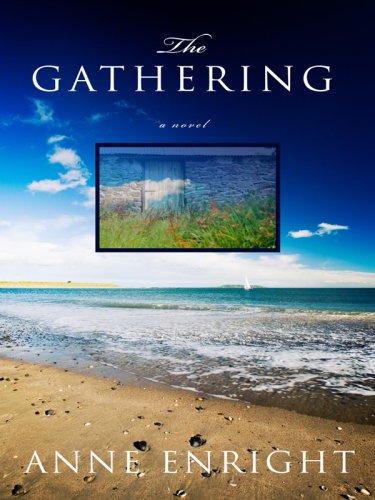
The Gathering
Anne Enright · b. 1962 · Ireland
Why it matters
Veronica Hegarty brings her brother's body home from Brighton and reconstructs (or invents) the moment in their grandmother's house that set his drowning in motion. Booker winner in 2007: grief anatomized with scalpel sentences and zero consolation.
At a glance
An unreliable narrator who revises her own scenes as she tells them; bleak material throughout.
Deep dive
Why Veronica keeps insisting she's making parts of this up — and why that confession is the most trustworthy thing she says in the whole book.
Written for readers who have finished the book. No plot recap, and nothing here is safe to read first.
Themes & symbolism
Veronica frames her own narration as reconstruction rather than record from the outset, admitting she's filling the gaps around her brother Liam's drowning with scenes she can't actually have witnessed — a formal choice that makes The Gathering less a mystery to be solved than a portrait of what grief does to the reliability of memory itself. The central, disputed scene, something that may or may not have happened to Liam as a child in their grandmother Ada's house involving a family friend, Lambert Nugent, is offered and re-offered in slightly different versions, and Enright never lets the reader arrive at a stable, confirmed account — the uncertainty isn't a withheld twist, it's the book's actual subject.
The large, chaotic Hegarty family, nine surviving siblings out of many more pregnancies, functions as its own argument about what gets preserved and what gets lost in a family this size: memory becomes communal property, endlessly renegotiated and never quite agreed on, so that Liam's death forces a reckoning nobody in the family has the shared facts to actually conduct. Veronica's own marriage, stable and outwardly unremarkable, sits in pointed contrast to her brother's disintegration and her own unraveling grief, and Enright uses that contrast to suggest survival in this family isn't virtue so much as luck in which wound you were dealt.
The Unreliable Elegy
Most novels built around an unreliable narrator eventually let the reader locate the truth underneath the distortion; Enright's innovation is refusing that payoff entirely; Veronica's admitted inventions stay uncorrected to the last page, so the book asks to be read not as a puzzle with a solution but as an honest record of how ungraspable a family tragedy actually is from inside it. That refusal is also a formal argument about grief writing generally — the traditional elegy comforts by making loss legible; Enright's version refuses the reader that comfort on principle.
Ada's House as a Structure of Secrets
The grandmother's house where the disputed childhood scene may have occurred recurs throughout the novel as a space Veronica keeps mentally re-entering and re-describing, its rooms and objects rendered with obsessive, escalating specificity each time — a technique that mimics how trauma is actually processed, in accumulating detail rather than single disclosure, and that leaves the reader as uncertain of the house's literal layout as of what happened inside it.
Where to go next
 Angela Carter · 1979The Bloody ChamberLvl 6Medium pace
 John McGahern · 1990Amongst WomenLvl 4Medium pace
 Rose Tremain · 2007The Road HomeLvl 3Medium pace
 Alice McDermott · 1998Charming BillyLvl 5Slow burn
 Julia Glass · 2002Three JunesLvl 4Medium pace
 Wang Anyi · 1995The Song of Everlasting SorrowLvl 6Slow burn