
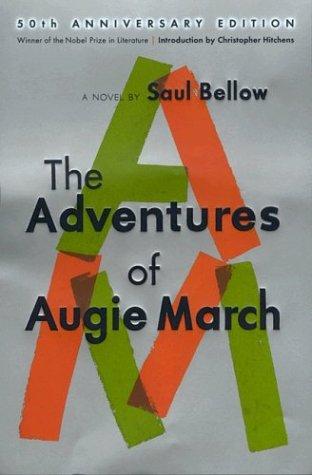
The Adventures of Augie March
Saul Bellow · 1915–2005 · Canada / USA
Why it matters
'I am an American, Chicago born,' and the American novel got a new voice: torrential, Yiddish-inflected, omnivorous. Bellow's picaresque broke Hemingway's spell and licensed exuberance again.
At a glance
Torrential, digressive sentences and a sprawling episodic structure resist quick reading.
Deep dive
What Augie March means when he calls his own life-strategy 'the opposition,' and why an eagle too timid to hunt is the novel's best portrait of its hero.
Written for readers who have finished the book. No plot recap, and nothing here is safe to read first.
Themes & symbolism
Augie's own term for his defining trait, repeated throughout the book, is "the opposition": an instinctive resistance to being remade in the image of whoever currently has a use for him. Grandma Lausch's old-world scheming, the crippled real-estate operator William Einhorn's Machiavellian realism, Thea Fenchel's grand romantic project of training an eagle named Caligula to hunt lizards in Mexico — each relationship on offer is a ready-made identity, a "line" in Augie's word for it, and each time he drifts loose rather than commit, which Bellow frames as freedom rather than failure of nerve, whatever it costs him in stability.
Caligula the eagle, magnificently built for killing and repeatedly too frightened to do it, is a deliberate mirror for Augie himself: an instrument that won't perform the function everyone around him assumes it exists for, disappointing in turn every character who tries to make use of it. Chicago itself, rendered in torrential, clause-stacking sentences that pile detail on ethnicity on incident the way the city piles neighborhood on neighborhood, is as much the novel's subject as its method — Bellow's famous opening declaration, "I am an American, Chicago born," announces a prose style built for abundance rather than the pruned, controlled short-story sentence that dominated the era's fiction.
The Opposition as Organizing Idea
Set against Augie's drift is his brother Simon, who takes the opposite path with total conviction, marrying into wealth and hardening himself into a ruthless operator — the life Augie is offered repeatedly and refuses each time. The novel isn't building toward Augie eventually choosing one of these available lines; "the opposition" is the plot, not an obstacle to it, which is why the book can range across jobs, cities, and mentors for five hundred pages without ever feeling like it's stalling.
Breaking the New Yorker Sentence
Bellow wrote the novel fast and loose after two tightly controlled early books, Dangling Man and The Victim, deliberately reacting against the era's dominant mode: the pruned, Flaubertian short story built around a single restrained epiphany. The result licensed a generation of American novelists — Roth and Updike among them, by their own accounts — to write with comparable appetite, and the book won the National Book Award in 1954 as the loud, digressive rebuttal to postwar fiction's good manners.
The last seal: what actually happens, and why it lands the way it does.
The ending, explained
After merchant-marine service, a torpedoing, and a surreal stretch adrift with a half-mad scientist scheming to synthesize life on a lifeboat, Augie ends up an adult hustler in postwar Europe, married to Stella, still without fortune or settled purpose. The closing lines have him comparing himself to a "Columbus of those near-at-hand," insisting that discovery doesn't require a far frontier — that the streets and people already in front of you hold as much to find as any New World, given the right appetite for looking. It's a defiantly anti-climactic close for a five-hundred-page novel: no fortune made, no mentor's plan fulfilled, which is exactly consistent with a book arguing all along that refusing to be finished is itself the achievement.
Where to go next
 Saul Bellow · 1964HerzogLvl 7Slow burn
 Saul Bellow · 1970Mr. Sammler's PlanetLvl 7Slow burn
 Saul Bellow · 1975Humboldt's GiftLvl 6Slow burn
 Philip Roth · 1969Portnoy's ComplaintLvl 5Fast paced
 Fyodor Dostoevsky · 1866Crime and PunishmentLvl 6Fast paced
 Isaac Bashevis Singer · 1960The Magician of LublinLvl 5Medium pace