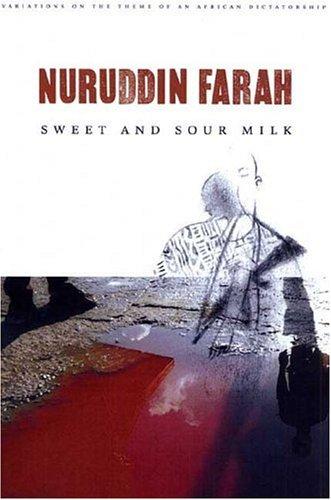
Sweet and Sour Milk
Nuruddin Farah · b. 1945 · Somalia
Why it matters
A doctor investigates his twin brother's sudden death, uncovering the dictatorship's informants inside his own family. The first novel of Farah's 'Dictatorship' trilogy: Somalia's paranoia and complicity rendered as unbearably intimate.
At a glance
Shifting perspectives and a slow-unfolding conspiracy require close attention to buried political detail.
Deep dive
Loyaan spends the novel trying to find out who silenced his twin brother, in a Somalia where naming the truth out loud is itself the crime.
Written for readers who have finished the book. No plot recap, and nothing here is safe to read first.
Themes & symbolism
Soyaan and Loyaan are twins raised identically who diverged completely: Soyaan rose inside the regime's own bureaucracy as an aide to the unnamed General who has ruled the country for a decade, while Loyaan trained as a dentist and stayed largely apart from politics. When Soyaan dies suddenly, crying his brother's name three times as he collapses, Loyaan's grief becomes an investigation almost by accident, since nobody around him, not his mother Qumman, not his sister Ladan, will give him a straight account of what happened.
Keynaan, the twins' father, supplies the novel's most chilling portrait of complicity: within days of Soyaan's death he is quoted in the state newspaper praising his dead son as a loyal servant of the General's revolution, a public lie that both erases the real, secretly subversive Soyaan Loyaan is piecing together and secures Keynaan's own standing with the regime. Farah makes Keynaan's patriarchal authority over his household, brutal, absolute, and answerable to no one, read as the family-sized version of the dictatorship outside it: a father who requires performed loyalty from his children is the same machine as a General who requires it from a nation.
Loyaan eventually learns his brother had been secretly compiling a memorandum documenting the regime's abuses, intending to smuggle it abroad, and had joined a small clandestine group opposed to the General, likely what got him poisoned. But Farah, writing the first novel of a trilogy pointedly titled Variations on the Theme of an African Dictatorship, refuses Loyaan a clean resolution. The identity of the poisoner, and the exact reach of the conspiracy around it, dissolves into conflicting testimony the novel never fully sorts out, an unresolvedness that is itself the point, close to what living under Siad Barre's actual surveillance state felt like for Farah, who went into exile not long after writing it.
The Same Name, Reissued
In the novel's last pages, Keynaan's second wife, Beydan, dies giving birth, and it is Ladan, the twins' sister and the household's most fearless voice, who insists the newborn be named Soyaan, reclaiming a name the state has just spent the whole novel trying to bury under an official, sanitized version of the dead man. It is a small act next to Loyaan's failed investigation, but Farah gives it the last word anyway, memory persisting through naming even when the machinery of an authoritarian state has made every other channel of truth-telling unsafe.
The last seal: what actually happens, and why it lands the way it does.
The ending, explained
Loyaan never conclusively proves who ordered his brother's poisoning, and the family and political threads he has spent the novel pulling collapse into contradictory rumor rather than a named culprit; Farah leaves the crime officially unsolved. What resolves instead is the household: Beydan dies delivering a child during the novel's final chapters, and Ladan claims the naming of the baby as Soyaan for herself, a direct, defiant answer to Keynaan's earlier co-opting of the dead man's memory for the regime's benefit. The novel closes on that private reclamation rather than on any public reckoning, insisting that under a dictatorship this thorough, keeping a name honest inside one family is already a considerable act of resistance.