
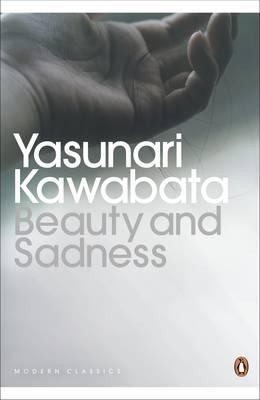
Beauty and Sadness
Yasunari Kawabata · 1899–1972 · Japan
Originally Utsukushisa to Kanashimi to (Japanese) · translated by Howard Hibbett
Why it matters
An aging novelist visits the former mistress he immortalized in fiction decades ago, not reckoning on her fiercely protective young protégée. Kawabata's late, coldest book: desire curdled into obsession and revenge.
At a glance
Shifting points of view and a simmering menace beneath placid surfaces.
Deep dive
An aging novelist travels to Kyoto to hear the New Year temple bells with the woman he once wrote into fame, not reckoning that her devoted young companion has spent years plotting exactly what to do about him.
Written for readers who have finished the book. No plot recap, and nothing here is safe to read first.
Themes & symbolism
Decades before the novel opens, the married novelist Oki had an affair with sixteen-year-old Otoko that ended in a premature, dying infant and Otoko's suicide attempt, then turned the whole episode into A Girl of Sixteen, the book that made his career. Kawabata builds the entire plot on the obscenity of that transaction: Oki got the finest book of his career out of a teenager's ruin, and returns to Kyoto years later, ostensibly to hear the year-end bells with Otoko, actually to reopen a wound he's never once considered might not still belong to him. Otoko, now a painter with a devoted younger companion, Keiko, receives him with a courtesy that reads, correctly, as armor rather than forgiveness.
Keiko is the novel's real engine. Having read Oki's novel and understood exactly what it cost the woman she loves, she sets out to avenge Otoko by seducing Oki's family from the inside, first drawing close to Oki himself and then to his grown son Taichiro, playing father and son against each other with a patience that never once tips into open confrontation. Kawabata gives Keiko's calculation the same still, glassy prose he gives everyone's desire, so that her revenge reads not as melodrama but as the last, coldest stage of an aesthetic that has run through the whole book: beauty as something wielded, precisely, to cause pain.
A Novel About the Novel That Caused It
A Girl of Sixteen sits inside Beauty and Sadness as an accusation that none of the characters can stop discussing. Oki treats it as his finest work and shows no sign of recognizing it as an act of appropriation; Otoko has spent her adult life painting partly to build an identity the novel didn't already own; Keiko reads it as the plainest possible evidence of what Oki is. Kawabata, writing this late in his career, uses the buried novel to indict the very aestheticizing gaze his own fiction is often praised for, the gaze that turns a sixteen-year-old's ruin into something beautiful enough to win a man his reputation.
The last seal: what actually happens, and why it lands the way it does.
The ending, explained
Keiko lures Taichiro out onto Lake Biwa in a motorboat, and in an accident the narration frames as anything but accidental, he drowns; Keiko may have drowned with him, though Kawabata keeps her fate as unresolved as everything else she's done. Otoko, Oki, and Taichiro's mother Fumiko converge afterward in Keiko's hotel room, and Fumiko accuses Otoko outright of having engineered her son's death in payment for the daughter Oki's novel cost her decades earlier. Nothing is confirmed and nothing is denied. Kawabata ends the novel exactly where his fiction usually ends, on an atrocity everyone can feel and no one will name, leaving Oki to understand, too late, that the beautiful young women around Otoko were never merely her companions.
Where to go next
 Yasunari Kawabata · 1947Snow CountryLvl 5Slow burn
 Yasunari Kawabata · 1952Thousand CranesLvl 5Slow burn
 Yasunari Kawabata · 1954The Sound of the MountainLvl 5Slow burn
 Yasunari Kawabata · 1954The Master of GoLvl 5Slow burn
 Yukio Mishima · 1956The Temple of the Golden PavilionLvl 6Slow burn
 Jun'ichirō Tanizaki · 1925NaomiLvl 4Fast paced