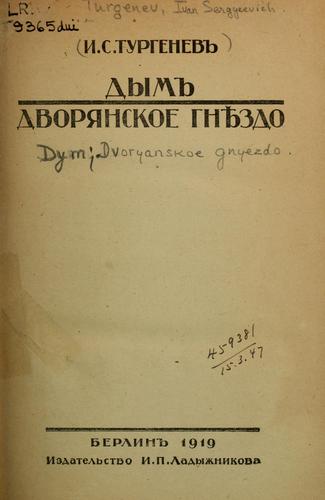
Smoke
Ivan Turgenev · 1818–1883 · Russia
Originally Dym (Russian)
Why it matters
A Russian idler drifts through the spa town of Baden-Baden, rekindling an old love affair while émigré factions around him argue Russia's future into so much smoke. Turgenev's bitterest social novel, disowned by radicals and reactionaries alike.
At a glance
Interpolated political debates slow an otherwise intimate love-triangle plot.
Deep dive
A Russian engaged to marry a sensible woman he loves runs into an old flame at a German spa town, and the novel widens what should be a simple temptation plot into a verdict on an entire expatriate class killing time abroad.
Written for readers who have finished the book. No plot recap, and nothing here is safe to read first.
Themes & symbolism
Grigory Litvinov arrives in Baden-Baden to wait for his fiancée Tatyana and instead collides with Irina Osinina, the woman he loved and lost a decade earlier, now married to a general and moving through the same resort society with a brittle, practiced glamour. Turgenev stages their reunion less as romance than relapse: Irina is bored, unhappy, and drawn back to Litvinov precisely because he still represents an earlier, unspoiled version of herself, while Litvinov mistakes the intensity of old feeling for evidence that it must be real and durable this time. Tatyana, patient and clear-sighted in a way neither of the two people deceiving each other can manage, becomes the standard the novel measures both of them against, and finds them wanting.
Around the love triangle, Turgenev builds two separate satirical portraits he clearly enjoyed writing more than the romance: a coterie of vacationing Russian generals whose political opinions amount to reflexive contempt for anything new, and a circle of radical intellectuals around the pompous Gubaryov who talk revolution in the abstract while contributing nothing concrete to it. Sozont Potugin, an acquaintance of Litvinov's given long, corrosive monologues on Russian cultural derivativeness, argues that Russia has borrowed its entire civilization from the West and produced almost nothing of its own, a claim so bleak that it drew outrage on publication from Slavophiles and radicals alike, each certain Turgenev meant it as an attack on them specifically. Potugin's bitterness carries real personal weight too: he loves Tatyana's cousin from a distance with the same hopeless persistence Litvinov shows toward Irina, so the novel's harshest political voice is also its loneliest character, a man with nowhere to put his own devotion either.
The Title's Image
Litvinov watches steam and smoke pour from a train and drift apart into nothing, and Turgenev lets the image stand for everything in the novel that feels urgent while it is happening and leaves no trace afterward: the generals' politics, Gubaryov's revolutionary talk, and, hardest for Litvinov to accept, his own reignited passion for Irina. The smoke never becomes a heavy-handed refrain; it appears once, early, and the rest of the book simply proves it right, scene by scene, without needing to point back at the image again.
The last seal: what actually happens, and why it lands the way it does.
The ending, explained
Irina promises to leave her husband for Litvinov, but stalls at the final moment, unwilling to trade her position and comfort for an uncertain life with a man of modest means, and Litvinov, humiliated, returns home to find that Tatyana has already left, having learned enough from his absence to understand what happened without needing it confessed to her. Years pass before Litvinov, now a modestly successful farmer who has rebuilt a quiet, useful life on his own estate, encounters Tatyana again and finds her willing to forgive him. Turgenev grants the couple a subdued reconciliation rather than a triumphant one, work and patience outlasting passion, which is exactly the verdict the smoke image predicted from the novel's first pages.