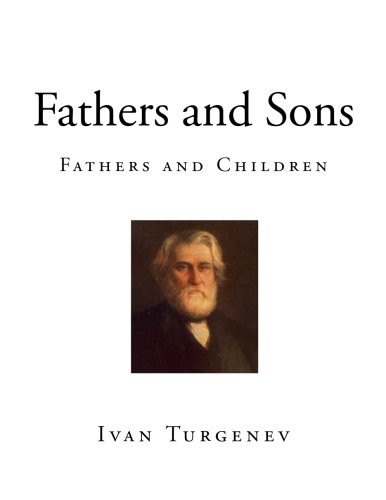
Fathers and Sons
Ivan Turgenev · 1818–1883 · Russia
Originally Ottsy i Deti (Russian)
Why it matters
Bazarov the nihilist (the word enters the world here) against his elders' liberal pieties, and against love, which defeats him. The subtlest novel of generational war, admired even by the radicals it offended.
At a glance
Restrained, conversational realism with clear scenes and a compact cast.
Deep dive
A self-declared nihilist who rejects every inherited value runs headlong into the one force his philosophy insists doesn't matter, and has to discover whether ideas can actually inoculate a person against feeling.
Written for readers who have finished the book. No plot recap, and nothing here is safe to read first.
Themes & symbolism
Bazarov's nihilism — a term the novel effectively coins for Russian political life — rejects tradition, romanticism, art, and authority wholesale in favor of hard materialist rationalism, and Turgenev stages the generational rupture with real evenhandedness: Bazarov's arguments with Arkady's gentle liberal father Nikolai and dandyish, Anglophile uncle Pavel are taken seriously as a live ideological contest rather than caricature, which is exactly why radicals accused Turgenev of slandering nihilism and conservatives accused him of glorifying it in the same book. Arkady himself supplies the novel's quieter counter-argument: rather than resolving the fathers-versus-sons conflict through Bazarov's confrontational path, he simply drifts back into comfortable domestic convention, marrying Odintsova's younger sister Katya, suggesting the 'sons' were never as uniform a generation as the argument assumes.
The novel's real irony is that Bazarov's own philosophy fails its first serious test: a man who has dismissed romantic love as sentimental self-delusion falls helplessly for the wealthy, self-possessed widow Anna Odintsova, whose caution and self-protectiveness keep her from ever risking her ordered life on him. Turgenev isn't staging a simple comeuppance — he's demonstrating that no system of ideas, however rigorously reasoned, can actually insulate a person from love, humiliation, or mortality, which is what makes Bazarov tragic rather than merely wrong.
A Word Enters the Language
Turgenev didn't invent "nihilist" from nothing, but Fathers and Sons is what fixed the word in Russian public life, and within a few years young radicals were adopting Bazarov's severe manner, his contempt for art and sentiment, his crude materialism, as an actual model to imitate rather than a fictional warning. That the character meant to dramatize a real generational crisis became instead a badge some of that generation wore proudly is its own ironic footnote to a novel already obsessed with the gap between ideas and the people who hold them. Turgenev, watching the reaction unfold from Paris, found himself attacked from both directions at once — too sympathetic to nihilism for conservative critics, too damning of it for the radicals — a reception that itself proved the novel's own quiet point about how badly ideology distorts anyone trying to read a whole person as a mere position instead of an actual life.
The last seal: what actually happens, and why it lands the way it does.
The ending, explained
Bazarov retreats to his own parents' modest home and throws himself into rural medical work, partly to outrun his feelings for Odintsova, and accidentally infects himself performing an autopsy on a typhus victim. He dies of the resulting infection, refusing religious consolation until his final hours, when he allows his devout mother one small, wordless mercy. His elderly parents' grief at his grave becomes the novel's closing image: ordinary, unideological human love outlasting even the most disciplined refusal of sentiment, the exact overwhelming feeling Bazarov's nihilism could never actually account for.