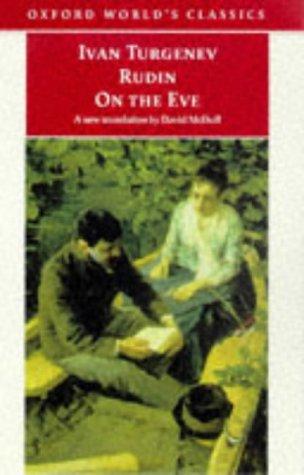
Rudin
Ivan Turgenev · 1818–1883 · Russia
Originally Rudin (Russian)
Why it matters
A brilliant talker charms a country household with idealistic speeches, then proves incapable of acting on a single one of them when love finally calls his bluff. Turgenev's first novel invented the 'superfluous man': all rhetoric, no follow-through.
At a glance
A compact, single-household plot told in clear, conversational realism.
Deep dive
A gifted talker mesmerizes an entire country household with speeches about purpose and self-sacrifice, and then discovers, the one time it actually matters, that he cannot act on a single word of it.
Written for readers who have finished the book. No plot recap, and nothing here is safe to read first.
Themes & symbolism
Dmitri Rudin arrives at Darya Lasunskaya's estate and immediately dominates every room with fluent, Hegelian-inflected talk about purpose, self-sacrifice, and the larger meaning of a life, rhetoric so persuasive that Darya's daughter Natalya falls in love with the ideas before she's entirely sure she's fallen in love with the man delivering them. Turgenev builds Rudin as the first fully realized version of what Russian criticism would soon start calling the 'superfluous man': brilliant, articulate, sincerely idealistic, and constitutionally incapable of translating any of it into action once real consequences are on the table.
The test arrives when Natalya, moved by everything Rudin has told her about living boldly, offers to defy her mother and run away with him, and Rudin, faced with the actual cost of the courage he's spent the whole novel praising in the abstract, hesitates, hedges, and effectively abandons her. Turgenev doesn't stage this as villainy; Rudin's collapse reads as entirely sincere, a man discovering in real time that his own eloquence was never load-bearing, that he had built an entire identity out of describing a kind of decisive life he is constitutionally unable to lead. Later Russian criticism would treat Rudin as the template the whole nineteenth-century tradition kept revising, Oblomov's paralysis and Chekhov's ineffectual gentry both readable as descendants of the same original diagnosis.
Lezhnev's Verdict, Revised
Lezhnev, an old university acquaintance who mocks Rudin's pretensions early in the novel, becomes over the course of the book its real moral authority, delivering two separate, deliberately contradictory judgments of him: first cutting and dismissive, later, once he's watched the full arc of Rudin's failure and persistent, threadbare idealism, unexpectedly generous, crediting Rudin with having genuinely inspired people even though he could never manage to live by his own words. Turgenev uses Lezhnev's reversal to do the work the plot itself refuses: deciding, out loud, whether a man this eloquent and this useless deserves contempt or sympathy, and landing, carefully, on both.
The last seal: what actually happens, and why it lands the way it does.
The ending, explained
An epilogue, added after the novel's initial serialization, catches up with Rudin years later, aged, poor, and still drifting between failed practical ventures with the same fine intentions and the same inability to see any of them through. Turgenev then places him, almost as an afterthought, on a Paris barricade during the June 1848 uprising, where he's shot and killed, mistaken by onlookers for a Polish agitator rather than recognized for anything he actually believed. It's the first and only fully decisive action Rudin takes in the entire novel, and Turgenev leaves deliberately unclear whether it counts as a redemption, a man finally matching action to word, or simply one more instance of a talker ending up in the wrong place, still explaining himself to people who were never listening.