
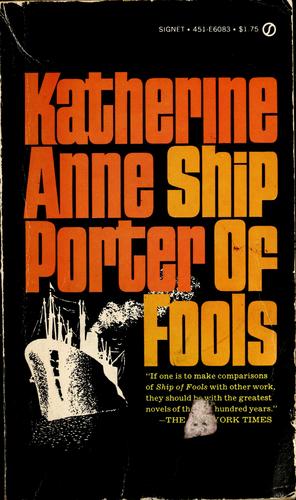
Ship of Fools
Katherine Anne Porter · 1890–1980 · United States
Why it matters
A transatlantic crossing in 1931 carries a cross-section of nationalities and prejudices toward a Europe sliding into fascism. Porter's only full-length novel, twenty years in the writing, a bestseller and a bleak allegory of complicity.
At a glance
A large ensemble cast tracked across many interwoven, ironic perspectives.
Deep dive
What Porter's 1931 transatlantic crossing, and the five-hundred-year-old satire she borrowed her title from, are cataloguing among the passengers of the Vera as it sails toward a Germany about to become unrecognizable.
Written for readers who have finished the book. No plot recap, and nothing here is safe to read first.
Themes & symbolism
Porter takes her title from Sebastian Brant's Das Narrenschiff, a 1494 satire that loaded an entire cast of vices onto one allegorical vessel, and she uses the same structure deliberately: no single passenger on the Vera gets protagonist status, so the folly on display belongs to an entire cross-section of German, American, Spanish, Swiss, and Mexican travelers rather than to one villain the reader can safely set apart from the rest. The ship is Europe in miniature, sailing in 1931 toward a Bremerhaven docking that the novel's original readers, writing and reading twenty years later, already knew was sailing straight into the rise of Hitler.
What actually indicts the passengers isn't violence, it's manners. Herr Freytag is quietly frozen out of the captain's table once it becomes known his wife is Jewish; Herr Lowenthal is mocked to his face over dinner by fellow Germans who consider themselves perfectly civil people. Porter's real subject is the ordinary, low-grade antisemitism exchanged as dinner conversation, the mechanism by which an entire society learns, politely and gradually, to tolerate what's coming, well before any of them have to actually choose a side.
The Zarzuela Troupe's Unpunished Cruelty
A traveling company of Spanish dancers and musicians turns out to be a small gang of extortionists and thieves, bullying a fellow performer's child, tormenting a passenger's small dog, and stealing from other travelers with almost no consequence from a crew and captain too class-conscious, or too cowardly, to discipline them. Porter stages their impunity as the novel's cruelty in miniature: a shipboard authority that sees the harm plainly and chooses not to intervene, which is exactly the failure the book indicts on a continental scale once the Vera reaches port.
Dr. Schumann and La Condesa, Diagnosed But Not Cured
The ship's physician and a Cuban political exile traveling under guard fall into a doomed shipboard romance that never gets to consummate itself, Dr. Schumann too bound by professional propriety and his own heart condition to act on what he feels. Porter uses the affair as a smaller mirror of the larger paralysis aboard: a man capable of real feeling who nonetheless does nothing decisive with it, which is the same charge the novel levels at nearly everyone on the passenger list.
Where to go next
 Katherine Anne Porter · 1939Pale Horse, Pale RiderLvl 6Medium pace
 Katherine Anne Porter · 1965The Collected Stories of Katherine Anne PorterLvl 6Medium pace
 Nathanael West · 1933Miss LonelyheartsLvl 6Fast paced
 Mavis Gallant · 2002Paris StoriesLvl 5Medium pace
 Sherwood Anderson · 1919Winesburg, OhioLvl 3Medium pace
 J. D. Salinger · 1951The Catcher in the RyeLvl 3Fast paced