
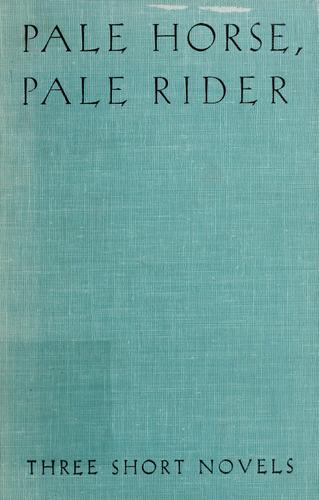
Pale Horse, Pale Rider
Katherine Anne Porter · 1890–1980 · United States
Why it matters
A wartime love affair burns against the 1918 influenza pandemic, its feverish delirium exactly rendered. Porter's short novel is among the finest American treatments of illness, mortality, and survival's guilt.
At a glance
Feverish, fragmented delirium-prose mirrors the illness it depicts.
Deep dive
A wartime romance unfolds against an epidemic the newspapers won't fully report, and Porter, drawing on an illness that nearly killed her, renders the fever itself in prose as disordered as the sickness — survival's strange, unbearable aftermath.
Written for readers who have finished the book. No plot recap, and nothing here is safe to read first.
Themes & symbolism
Porter sets Miranda's romance with Adam against two overlapping catastrophes neither official channel will name honestly: the war, which wartime censorship keeps sanitized and heroic in the papers Miranda writes for, and the 1918 influenza, which was killing more Americans at home than combat was killing overseas, its true scale suppressed to protect morale. The novel's atmosphere of aggressive patriotic conformity — Miranda hounded to buy Liberty Bonds she can't afford, watched for insufficient enthusiasm — makes the whole world she and Adam move through feel coercive and dishonest even before illness enters it, so that their romance carries an charge of stolen time from the start, two people snatching intimacy from a system organized to consume both of them.
Once Miranda herself falls ill, Porter's prose breaks from realist narration into a sustained fever-delirium mode — fragmented, hallucinatory, temporally scrambled, mixing sickroom sensation with memory and unbidden vision in a way that has become a touchstone for literary renderings of altered consciousness. The technique isn't showing off: it's the novel's argument in miniature, that illness dissolves the ordinary boundary between interior and exterior, self and world, exactly as war dissolves the boundary between the battlefield and the home front the newspapers pretend is safe. The novella's closest biographical root is Porter's own near-fatal 1918 flu, which she said turned her hair white and left her with something like a permanent, clarifying nearness to death she spent her career writing back toward.
Survivor's Guilt as the Real Subject
The novella's title, drawn from the spiritual about the biblical pale horse of Revelation carrying death, frames illness and war as versions of the same indiscriminate rider, and Porter's real interest lies less in the illness itself than in what it's like to be left behind by it — to recover into a world that has kept moving without you and that has no real frame for what you've been through. Miranda's alienation afterward isn't temporary convalescence but a permanent shift in her relationship to time and other people, the ordinary world's business-as-usual reading, to her, as a kind of willful unseeing of what she now knows death actually feels like from the inside. Porter treats this not as melodrama but as a documented, closely observed psychological state, drawn precisely from her own recovery.
The last seal: what actually happens, and why it lands the way it does.
The ending, explained
Miranda survives the influenza against real odds — the 1918 pandemic killed a striking share of victims her age — but Porter denies her any reunion to survive toward: a delayed telegram, arriving only once she's well enough to receive news, tells her that Adam has died of the same flu, having caught it, implicitly, through nursing her during her worst days, his devotion becoming the mechanism of his own death. The war ends in the same stretch of time, and the novella's final scene finds Miranda listening to celebration erupting in the streets outside her hospital window, alive and recovering but finding the city's relief obscurely unbearable, closer to noise than meaning. Porter's closing note is a muted, almost paradoxical survivor's peace — not resolution but a kind of flattened aftermath, Miranda restored to health and to a life that no longer contains the one person she most wanted to carry it back to.
Where to go next
 Katherine Anne Porter · 1962Ship of FoolsLvl 6Slow burn
 Katherine Anne Porter · 1965The Collected Stories of Katherine Anne PorterLvl 6Medium pace
 Nathanael West · 1933Miss LonelyheartsLvl 6Fast paced
 Mavis Gallant · 2002Paris StoriesLvl 5Medium pace
 Sherwood Anderson · 1919Winesburg, OhioLvl 3Medium pace
 J. D. Salinger · 1951The Catcher in the RyeLvl 3Fast paced