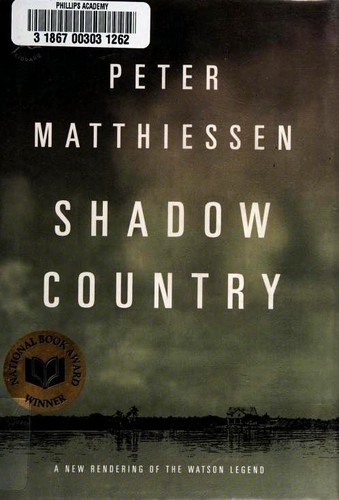
Shadow Country
Peter Matthiessen · 1927–2014 · United States
Why it matters
Multiple conflicting witnesses reconstruct the life and disputed murder of Edgar Watson, a real Everglades planter and outlaw feared across Florida's violent frontier. Matthiessen's radically condensed trilogy won the National Book Award, an unprecedented feat for reworked earlier fiction.
At a glance
Multiple unreliable narrators circle the same disputed events across nearly a thousand pages.
Deep dive
How Peter Matthiessen tells the story of one Florida planter's violent end three separate times, in three separate registers, and lets who actually pulled the trigger stay less important than why an entire island needed to believe its own version.
Written for readers who have finished the book. No plot recap, and nothing here is safe to read first.
Themes & symbolism
Shadow Country compresses Matthiessen's original trilogy, Killing Mister Watson, Lost Man's River, and Bone by Bone, into a single novel built around Edgar J. Watson, a planter and cane grower in Florida's Ten Thousand Islands whose neighbors both admired his ambition and quietly believed him responsible for a string of unsolved deaths. Book One assembles a dozen first-person witnesses recalling Watson's life and end from a dozen conflicting angles, none of them fully trustworthy, all of them shaped by what the teller needs Watson to have been.
Book Two hands the search to Watson's son Lucius, an amateur historian trying to write an objective biography of his own father, and Matthiessen uses that project to dramatize how thoroughly legend has replaced fact: every islander Lucius interviews has a Watson story that serves that islander's own sense of the community's honor, and the closer Lucius gets to documentary truth, the less anyone around him wants him to publish it.
Book Three finally gives Watson himself the narration, and the shift is the novel's boldest structural move: after two books of Watson refracted through everyone else's need for him to be either a self-made man or a monster, hearing his own account, resentful, calculating, sometimes self-aware, reframes the entire community's collective violence against him as an act they needed a story to justify. Matthiessen's real subject turns out to be less Watson than the island's appetite for a legend clean enough to live with.
The Ten Thousand Islands as an Unpoliced Frontier
Matthiessen, better known before this book as a naturalist, grounds Watson's story in exact ecological and economic detail: the sugarcane operation Watson pioneers, the plume-hunting and mullet fishing that sustain his neighbors, a landscape so remote that law arrives, when it arrives at all, as whatever consensus the community can improvise for itself. That absence of formal justice is what makes the mob's final verdict on Watson possible, and Matthiessen never lets the reader forget that the islanders' vigilante violence and Watson's own alleged crimes come from the identical frontier logic.
The last seal: what actually happens, and why it lands the way it does.
The ending, explained
As Watson's motorboat arrives at Chokoloskee Bay after another suspicious disappearance among his hired hands, a tense crowd of armed neighbors is already waiting. Watson steps ashore carrying a shotgun, exchanges a few tense words, and the crowd opens fire, more than thirty rounds, before he can raise the gun himself. Matthiessen never resolves which individual fired the fatal shots, and Lucius's decades-long investigation in Book Two never manages to either, because the killing was communal by design, a mob's justice distributed across enough hands that no single islander has to carry it alone. Book Three's turn to Watson's own voice doesn't solve the mystery either; it simply confirms that Watson, like everyone who has taken a turn narrating him, was constructing his own version of events until the moment the community's story overtook his.