
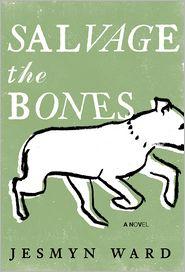
Salvage the Bones
Jesmyn Ward · b. 1977 · United States
Why it matters
A pregnant teenage girl and her brothers prepare their rural Mississippi home for Hurricane Katrina across twelve mythic, unsparing days. Ward's first National Book Award winner reads the storm as apocalypse and family loyalty as the only shelter.
At a glance
Dense, mythic prose tracks a family through twelve days toward Katrina.
Deep dive
A pregnant teenager spends twelve days getting her family ready for Hurricane Katrina, and Ward builds the whole countdown out of Greek myth.
Written for readers who have finished the book. No plot recap, and nothing here is safe to read first.
Themes & symbolism
Esch's pregnancy, discovered and mostly concealed across the novel's twelve days, runs in deliberate counterpoint to China the pit bull's own recent, violent labor and fierce protection of her surviving puppies: Ward stages motherhood in this novel almost entirely through animal and female bodies under threat, with China's raw physical ferocity toward anyone approaching her litter offering Esch a model of maternal power her own situation — pregnant by Manny, who barely acknowledges her, in a household of brothers and a grieving, absent father — otherwise denies her any access to.
Esch's ongoing reading of Edith Hamilton's Mythology throughout the novel, and her repeated identification with Medea specifically, gives the narrative a formal scaffolding beneath its realist surface: Esch reads her own betrayal by Manny, her family's precarious survival, and the hurricane bearing down on them all through a mythic register that elevates the family's rural Mississippi poverty to the scale of Greek tragedy without ever condescending to it, insisting that this family's suffering and endurance carry the same weight as the stories Esch is reading.
Hurricane Katrina itself, arriving only in the novel's final stretch after eleven days of anticipation and preparation, functions less as a plot event than as a force that strips away every illusion of control the characters maintained beforehand — Skeetah's fixation on saving China's remaining puppy, Randall's basketball ambitions, Esch's concealed pregnancy — reducing the family, in the flood's immediate aftermath, to the most basic and clarifying question of who survives and who is saved, and the novel's answer is entirely about the fierce, imperfect loyalty of family rather than any external rescue.
Twelve Days Structured Like Myth
Ward organizes the novel into a tight twelve-day countdown to landfall, a compression that gives the narrative a tragedy's classical unity of time even as its content stays resolutely domestic and specific — dogfighting, a leaking roof, a family's slowly depleting food stores — and the mythic scaffolding Esch reaches for isn't authorial ornament so much as a working-class Mississippi teenager's actual sense-making tool, evidence of a rich interior life the world around her rarely bothers to notice. Ward has said she wrote the novel in part to correct the near-total absence of poor, rural, Black Gulf Coast lives from the national narrative Hurricane Katrina generated, and the National Book Award recognition that followed helped cement Salvage the Bones as the literary counter-record to that gap.
The last seal: what actually happens, and why it lands the way it does.
The ending, explained
As Katrina's floodwaters rise faster and higher than anyone anticipated, the family shelters first in the attic and then, as the water keeps climbing, on the roof and finally in a tree, watching their house and most of their possessions get swept away or ruined; Skeetah nearly drowns retrieving China's last surviving puppy, and the family survives the storm itself only through sheer endurance and mutual reliance, with no outside rescue arriving in any meaningful way. In the aftermath, surveying the wreckage of the only home she's known, Esch finally tells her brothers about her pregnancy, choosing disclosure and the family's imperfect but real support over continuing to hide it, and resolves she'll raise the child within this family rather than wait on Manny, who has already made clear he wants none of it. The novel closes on survival stripped to its barest terms — a devastated house, a decimated litter of puppies, a family with nothing left but each other — and treats that reduction as the clearest proof of what actually holds this family together.
Where to go next
 Jesmyn Ward · 2017Sing, Unburied, SingLvl 5Medium pace
 Toni Morrison · 1987BelovedLvl 8Slow burn
 William Faulkner · 1930As I Lay DyingLvl 9Medium pace
 Eudora Welty · 1972The Optimist's DaughterLvl 4Medium pace
 Cormac McCarthy · 1992All the Pretty HorsesLvl 6Medium pace
 Gabriel García Márquez · 1967One Hundred Years of SolitudeLvl 6Medium pace