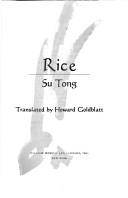
Rice
Su Tong · b. 1963 · China
Originally Mi (Chinese) · translated by Howard Goldblatt
Why it matters
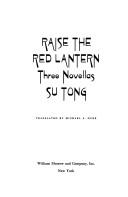
A starving village boy claws his way to power in a corrupt rice-shop dynasty, his hunger curdling into cruelty toward everyone who ever pitied him. Su Tong's harshest novel, as claustrophobic as Raise the Red Lantern but without any of its lyricism's mercy.
At a glance
An unsparing, morally bleak descent offers no sympathetic vantage to soften its cruelty.
Deep dive
A starving village boy claws his way into a corrupt rice-shop dynasty through both of the owner's daughters, and Su Tong is far more interested in what winning does to him than in whether he wins.
Written for readers who have finished the book. No plot recap, and nothing here is safe to read first.
Themes & symbolism
Five Dragons arrives in the city with nothing after floodwaters wreck his village, and the rice shop he talks his way into becomes both his salvation and the mechanism of his corruption: every early humiliation he absorbs there, sleeping on rice sacks, mocked by the owner's family, gets logged and eventually repaid with a cruelty that outscales the original offense many times over. Su Tong builds the novel almost entirely on this ledger logic, hunger converting into ambition converting into violence, and refuses the reader any point where Five Dragons's suffering earns him sympathy rather than simply explaining what he becomes.
Rice itself, the substance that nearly kills Five Dragons through its absence and then defines the empire he builds, stays a genuinely ambivalent symbol rather than a stable one: it's nourishment, currency, inheritance, and eventually obsession, since Five Dragons's late fixation on hoarding and handling grain reads less like a survivor's caution than a compulsion that has outlived any rational purpose. His marriages into the rice-shop family, first to one daughter and then effectively to both, extend the same logic from grain to women, each relationship less an attachment than another asset seized to settle an old account.
A Family Saga With No One to Root For
Su Tong strips the family-saga form of the sympathetic anchor it usually provides: the rice-shop family Five Dragons infiltrates is vicious before he arrives, and his own eventual cruelty to them reads less as revenge against a specific wrong than as an equal continuation of the family's baseline. The two daughters he marries, their brother, their aging patriarch, all get their own moments of vindictiveness and self-interest, and by the novel's second half essentially every character has done something disqualifying. Su Tong's refusal to let the plot settle into victims and villains is the book's clearest formal decision, harsher even than the more lyrical cruelty of Raise the Red Lantern, and it's what makes Rice read as a study of an entire social order rather than one man's individual descent.
The last seal: what actually happens, and why it lands the way it does.
The ending, explained
Five Dragons spends the second half of the novel consolidating power over the rice shop and its family through sheer ruthlessness, only to find that the enemy his ambition never anticipated is his own body: he contracts a severe venereal disease just as the Japanese invasion reaches the city, and the infection, not any rival or reversal of fortune, is what finally breaks him. Su Tong lets the historical catastrophe arrive almost as an afterthought next to Five Dragons's private one, the man who clawed his way out of starvation and into an empire of grain dying by an appetite he never learned to control, his hoarded rice worth nothing against a body that has already begun failing him from the inside.