
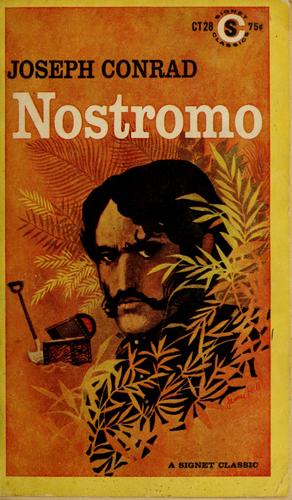
Nostromo
Joseph Conrad · 1857–1924 · Poland / England
Why it matters
An invented South American republic, a silver mine, and the corruption of every ideal in its orbit. Many call it the greatest political novel in English: the resource curse diagnosed before the term existed.
At a glance
Non-chronological structure, huge cast, and dense political and economic detail.
Deep dive
Conrad's most sprawling novel, about a fictional South American republic and the silver mine that ends up owning everyone who claims to own it.
Written for readers who have finished the book. No plot recap, and nothing here is safe to read first.
Themes & symbolism
The San Tomé silver mine is Nostromo's real protagonist, in the sense that every human character's fate bends around it: Charles Gould inherits his father's ruined obsession with the mine and rebuilds it as an idealistic instrument of order and stability for Costaguana, only to watch that idealism curdle, by the novel's end, into the same possessive, amoral 'material interests' he set out to redeem the country from. Conrad's famous, bitter formulation — that material interests, once let loose, 'are given a moral cover' by whatever ideals happen to be riding on them at the time — is less a throwaway line than the whole novel's thesis, illustrated across dozens of characters who each believe their motives are separate from the silver's and are each, eventually, revealed to be instruments of it.
Nostromo himself, the 'incorruptible' Genoese sailor whose entire social value depends on other people's need for someone reliably self-sacrificing, is quietly destroyed by the one act of theft the narrative structure works hardest to obscure: entrusted to save the silver from revolutionary capture, he and Martin Decoud sink the loaded lighter offshore, and Nostromo — believing himself abandoned and unrewarded by the very oligarchs who built his reputation on his unrewarded selflessness — secretly starts drawing off the recovered treasure for himself, becoming, in private, exactly the kind of man his public reputation had always denied he could be.
Martin Decoud's suicide, alone for days on the Great Isabel with the hidden silver and no audience left to perform his skepticism for, is the novel's bleakest set piece: a man whose entire personality was constructed out of ironic detachment and an audience of Parisian salons discovers that irony has no traction against total solitude, and simply shoots himself rather than continue existing without anyone to be witty for — Conrad's harshest verdict on a certain kind of self-regarding modern intelligence.
Conrad's Other Colonial Novel
Where Heart of Darkness compresses its critique of imperial extraction into a single claustrophobic river journey and one European's collapse, Nostromo widens the same argument into a full invented national history — political factions, revolutions, foreign capital, decades of backstory — set in the fictional South American republic of Costaguana rather than the real Congo. The panoramic scale lets Conrad trace how material interests entrench themselves at the level of an entire society's institutions rather than one man's psyche, and the two novels are worth reading against each other as the same diagnosis delivered at two radically different magnifications.
The last seal: what actually happens, and why it lands the way it does.
The ending, explained
Believing the silver lost and separately convinced he's been treated as expendable by the men who used his reputation, Nostromo has spent years secretly retrieving and hoarding treasure from the sunken lighter, growing rich under a false identity while his public legend as the one incorruptible man in Costaguana remains untouched. Circling back to the isolated island where the silver is hidden to court Giselle Viola, he's mistaken in the dark for an intruder by her father, old Giorgio Viola — a fiercely principled revolutionary who has armed himself against exactly the kind of predatory suitor he fears for his daughters — and shot dead by the very man whose trust in Nostromo's honor was total. Nostromo dies with his theft and his double life still unconfessed, his reputation intact only because no one lives to correct it, and the silver's corrupting hold outlasts him precisely because it was never really about the republic's fate at all, only about who got to possess it.
Where to go next
 Joseph Conrad · 1899Heart of DarknessLvl 7Slow burn
 Joseph Conrad · 1900Lord JimLvl 8Slow burn
 Ford Madox Ford · 1915The Good SoldierLvl 7Slow burn
 Gustave Flaubert · 1857Madame BovaryLvl 5Slow burn
 Tayeb Salih · 1966Season of Migration to the NorthLvl 7Slow burn
 James Joyce · 1914DublinersLvl 3Slow burn