
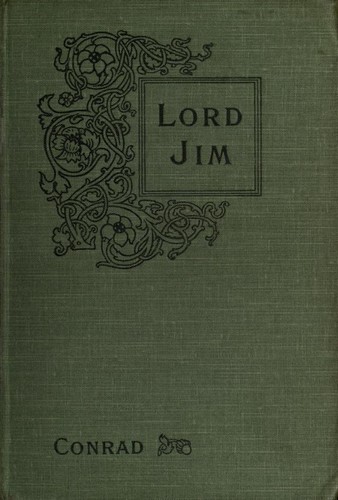
Lord Jim
Joseph Conrad · 1857–1924 · Poland / England
Why it matters
One moment of cowardice, a lifetime of atonement, told through Marlow's circling, uncertain testimony. Conrad's nested narration made the 'how' of telling part of the story: a lesson Faulkner and Fitzgerald took to heart.
At a glance
Fragmented, achronological narration filtered through Marlow's uncertain retelling.
Deep dive
A young officer's single, instinctive act on a stricken pilgrim ship sets the terms for everything he does afterward, and Conrad builds an entire narrator, Marlow, just to keep circling the question of what that act actually proves.
Written for readers who have finished the book. No plot recap, and nothing here is safe to read first.
Themes & symbolism
Conrad never lets the reader witness the jump off the Patna directly. Marlow assembles it secondhand, from testimony, gossip, and Jim's own halting confession, years after the fact, and that structural evasion is the novel's real subject: Jim's whole life becomes an attempt to narrate himself out of a moment nobody, including Jim, can fully reconstruct. The Patna doesn't sink after the officers abandon her and her eight hundred sleeping pilgrims, which means Jim's crime has no body count to anchor it, only the unbearable fact of the impulse itself, an instinct that beat his idea of who he was by a fraction of a second.
Marlow's fascination with Jim runs past ordinary curiosity into something closer to self-interrogation. He tells Jim's story to a room of listeners because he needs, as much as Jim does, to know whether one failure of nerve damns a man permanently or whether character can be rebuilt somewhere the old reputation can't follow. Patusan, the remote settlement where Jim finally earns the name Tuan Jim, functions as Conrad's laboratory for that question: cut off from the seafaring world that tried and humiliated him, Jim gets to construct, from nothing, the version of himself that jumping off the Patna denied.
Gentleman Brown, the marauding renegade who arrives late and reads Jim's guilt with predatory precision, exists to prove that Jim's Patusan self was never as separate from his Patna self as Jim wanted to believe. Brown needles Jim by insisting they're the same kind of man, both capable of the identical failure under pressure, and Jim's decision to let Brown's men leave unharmed, trusting a code of honor Brown has no intention of honoring, replays the Patna's logic exactly: a man mistaking his own idealized self-image for the actual situation in front of him.
Marlow as Unreliable Judge
Conrad's choice to filter almost the entire novel through Marlow, rather than Jim directly, keeps the book's verdict permanently unsettled. Marlow admires Jim, defends him to skeptical listeners, and still cannot decide whether Jim is redeemed or merely repeating his original error in a more flattering setting. That refusal to adjudicate was radical for 1900: English fiction expected a moral to land, and Conrad instead hands readers a narrator who has spent years thinking about one man's character and still doesn't trust his own conclusion, which is the point. Jim is legible only through the gaps and contradictions in how other people describe him.
The last seal: what actually happens, and why it lands the way it does.
The ending, explained
Brown's men, allowed to retreat under Jim's guarantee of safe passage, ambush the Bugis forces instead and kill Dain Waris, the son of Jim's closest ally, chief Doramin. The betrayal exposes what the whole novel has been building toward: Jim's honor code, sincerely held, is no match for an opponent with none. Rather than flee, as he did off the Patna, Jim walks unarmed into Doramin's compound and submits to the old chief, who shoots him dead in front of the assembled community as payment for his son's life. Conrad frames the death as Jim's only possible redemption of the original jump, a second test of nerve under lethal pressure that he does not fail this time, but the novel refuses to call it a triumph. Jim dies obscure and far from the world that tried him, and Marlow's last word on him is uncertainty rather than judgment.
Where to go next
 Joseph Conrad · 1899Heart of DarknessLvl 7Slow burn
 Joseph Conrad · 1904NostromoLvl 8Slow burn
 Ford Madox Ford · 1915The Good SoldierLvl 7Slow burn
 Gustave Flaubert · 1857Madame BovaryLvl 5Slow burn
 Tayeb Salih · 1966Season of Migration to the NorthLvl 7Slow burn
 James Joyce · 1914DublinersLvl 3Slow burn