
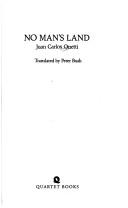
No Man's Land
Juan Carlos Onetti · 1909–1994 · Uruguay
Originally Tierra de nadie (Spanish)
Why it matters
A mosaic of aimless Buenos Aires bohemians, failed revolutionaries, and broken affairs, none of them quite touching one another. Onetti's first novel, already fluent in the moral exhaustion that would define his Santa María fiction a decade later.
At a glance
A fragmented ensemble cast and elliptical, disconnected scenes resist a single throughline.
Deep dive
What a Buenos Aires generation invents when it decides the city has nothing left to offer, and why the novel it produces still doesn't believe its own escape route.
Written for readers who have finished the book. No plot recap, and nothing here is safe to read first.
Themes & symbolism
Onetti's Buenos Aires in No Man's Land is less a setting than an exhaustion, a city its characters, mostly writers, gallery owners, and idle bohemians drifting between affairs, treat as thoroughly used up, and the novel's fragmented structure, jumping between a dozen loosely connected figures rather than following a single throughline, mimics that exhaustion formally: no one storyline earns enough sustained attention to feel like the center, because Onetti's real subject is a milieu that has stopped believing anything deserves sustained attention.
Faruru, a Polynesian island the old philosopher Num describes to the drifting protagonist Aránzuru, an unmapped territory where nothing done can harm anyone or interest anyone else, functions as the novel's clearest fantasy of escape and its clearest admission that escape is fictional. Num can't produce the island on any map, and Onetti never lets Aránzuru or the reader treat Faruru as anything but a story someone is telling to make the unbearable city bearable a little longer, a paradise built entirely out of the need for one to exist.
Aránzuru's affair with Nené, which ends in an abortion he registers mostly through his own detachment rather than any grief on her behalf, exemplifies how thoroughly Onetti's characters have stopped being able to feel their own lives directly. Love, pregnancy, loss all arrive filtered through a numbness the novel treats as the era's real diagnosis, not individual coldness but a whole generation's response to a world war and a home city that both feel equally unreal.
Onetti's Debut, Everyone Else's Later Territory
Published in 1941, No Man's Land is Onetti's first novel and the first appearance of the fractured, disillusioned voice he would spend the next four decades refining. Before Santa María, his invented town, gave his fiction a fixed geography, this early Buenos Aires is where he worked out the tone, corrosive, unsentimental, allergic to any character's self-justification, that would define everything from The Shipyard to A Brief Life. Read alongside those later, more disciplined novels, No Man's Land shows Onetti still discovering how much narrative cohesion he was willing to sacrifice for atmosphere, and the answer, even here, is almost all of it.
The last seal: what actually happens, and why it lands the way it does.
The ending, explained
The novel doesn't resolve into any single character's fate so much as let its scattered plotlines run down simultaneously: Aránzuru's drift continues without any decisive break, Nené's abortion passes without confrontation or consequence exacted from anyone, and Num's Faruru remains exactly as unreachable at the novel's close as it was the day he first described it. Onetti denies the reader the conventional payoff of watching a fragmented ensemble finally converge, because convergence would concede that this Buenos Aires, and the people scattered across it, still add up to something. The book's real ending is the absence of one, its refusal to let any of its characters arrive anywhere they can call a destination.
Where to go next
 Juan Carlos Onetti · 1950A Brief LifeLvl 8Slow burn
 Juan Carlos Onetti · 1961The ShipyardLvl 8Slow burn
 William Faulkner · 1930As I Lay DyingLvl 9Medium pace
 Juan Rulfo · 1955Pedro PáramoLvl 7Slow burn
 Carlos Fuentes · 1962The Death of Artemio CruzLvl 8Slow burn
 Mario Vargas Llosa · 1963The Time of the HeroLvl 6Medium pace