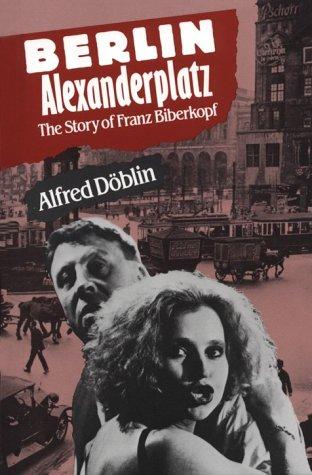
Berlin Alexanderplatz
Alfred Döblin · 1878–1957 · Germany
Originally Berlin Alexanderplatz (German)
Why it matters
An ex-convict's attempts to go straight in Weimar Berlin collide with pimps, politics, and the city's own overwhelming noise. Joycean montage applied to a single desperate man in a capital sliding toward catastrophe.
At a glance
Montage of voices, slang, and found text in the Joycean vein.
Deep dive
An ex-convict keeps swearing he'll go straight, and Doblin builds an entire city's noise around him to prove how little that vow is worth against Berlin.
Written for readers who have finished the book. No plot recap, and nothing here is safe to read first.
Themes & symbolism
Franz Biberkopf's repeated vows to 'stay decent' after his release from Tegel prison are structured as a cycle Doblin stages three times with mounting cruelty — each time Franz finds precarious stability, the city or his own compulsions pull him back under, first through the con man Lüders robbing his first sympathetic lover, then through his entanglement with Reinhold and the criminal gang that costs him an arm, then finally through Reinhold's murder of Mieze, the one relationship that seemed to offer him something like real tenderness. The novel's structure of return isn't fatalism exactly; it's an argument that individual willpower is no match for a city, and an economy, organized to keep a man like Franz permanently one bad break from prison.
Doblin's montage technique — splicing in newspaper clippings, weather reports, advertising slogans, stock prices, biblical and mythological allusion, snatches of overheard dialogue, and the Alexanderplatz's own traffic noise directly into Franz's narrative — makes the city itself a kind of co-protagonist, a total environment pressing in on individual consciousness from every direction at once. The technique, openly indebted to Joyce's Ulysses, isn't decorative virtuosity so much as the novel's claim about what urban modernity actually does to a single perceiving mind: Franz's story can't be told in isolation from the roar surrounding it, because the roar is precisely what keeps overwhelming his attempts at a private, orderly life.
Reinhold functions less as a conventional villain than as a kind of embodied fate or death-drive that Franz keeps returning to even after Reinhold has cost him an arm — the recurring image of the slaughterhouse (Franz works briefly near one, and Doblin threads slaughterhouse imagery and biblical sacrifice, especially the Abraham and Isaac story, through the whole novel) frames Franz less as an individual moral agent than as a kind of sacrificial animal the city and its criminal underworld keep offering up, over and over, with Franz's own passivity toward Reinhold reading as something close to a wish to finally be broken all the way down.
A Weimar Novel Written Under the Shadow of What Came Next
Published in 1929, months before the Wall Street crash accelerated Weimar Germany's slide toward political catastrophe, Berlin Alexanderplatz captures a specific, saturated moment of urban chaos, unemployment, and competing ideological street violence (Nazi and Communist agitators both appear jostling for Franz's allegiance) without yet knowing where it was heading — which gives the novel's atmosphere of directionless churn a documentary weight later readers can't help reading retrospectively as prophecy. Doblin, a practicing physician as well as a novelist, drew on real Weimar case histories and Berlin criminal argot for the book's texture; the Nazis later burned his books and forced him into exile, a fate the novel's own churning, unstable Berlin seems, in hindsight, to have been anxiously circling the whole time.
The last seal: what actually happens, and why it lands the way it does.
The ending, explained
After Reinhold murders Mieze and Franz, wrongly implicated, is cornered by police, he starves himself into a catatonic state and is committed to an asylum, where the novel stages a hallucinatory sequence: Death itself confronts Franz and strips away every excuse he's clung to, while Mieze's spirit appears asking to be let go rather than mourned into paralysis. Franz 'dies' in this confrontation in every sense but the literal one — the old Biberkopf, defined by bluster and doomed vows of decency, is dissolved — and emerges quieter, chastened, taking a modest job as an assistant doorman, no longer insisting he can simply will himself straight. Doblin refuses to call this a happy ending; Franz's survival is real but diminished, and the closing pages, still cutting in newsreel fragments of the city's indifferent noise, make clear Berlin will go on producing more Franz Biberkopfs regardless.