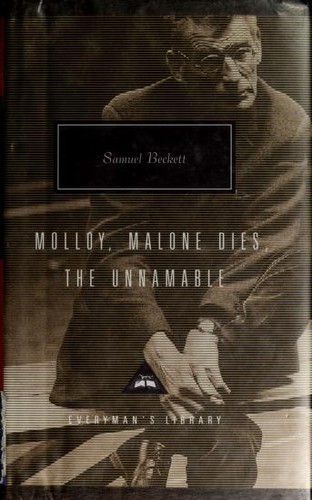
Malone Dies
Samuel Beckett · 1906–1989 · Ireland / France
Originally Malone meurt (French)
Why it matters
A dying man tells himself stories to pass the time until the end, narrating his own extinction. The middle panel of Beckett's great trilogy: consciousness stripped to voice, waiting, and the compulsion to keep speaking.
At a glance
Circular, self-canceling monologue with almost no plot or paragraph breaks.
Deep dive
A dying man in a bare room fills his last hours inventing another man's life story, and Beckett lets the telling itself start to give out along with him.
Written for readers who have finished the book. No plot recap, and nothing here is safe to read first.
Themes & symbolism
Malone, confined to a bed in a bare room he can't identify as hospital, hospice, or asylum, splits his remaining time between what he calls current events, his stick, his exercise book, the pot he urinates into, and a story he's inventing about a man named Saposcat, later renamed Macmann, whose sordid, aimless picaresque gives Malone something to narrate that isn't his own approaching death. The invented story keeps interrupting itself with Malone's commentary on his own failing control over it, so the reader watches two declines at once, Macmann's fictional one inside the tale and Malone's actual one outside it, without ever being sure which is propping up which.
The compulsive cataloguing of Malone's possessions, a hat, a pencil stub, boots, a pot, is Beckett's bleakest joke about the self reduced to inventory: as memory and body fail, Malone clings to the only form of narrative still available to him, a list, since a list requires no causation, no development, nothing but naming what's still there. The list keeps growing thinner as the novel proceeds, and Beckett lets that thinning stand in for everything else he refuses to describe directly, decline rendered as subtraction rather than event.
Macmann as Malone's Last Fiction
Macmann drifts through a series of degrading episodes, most extensively a long stretch in the House of St. John of God under the sadistic attendant Lemuel, that mirror Malone's own condition, confinement, physical humiliation, dependency on strangers, without ever announcing the parallel outright. Beckett uses the doubling to ask what fiction is actually for when a writer has nothing left to gain from telling stories, not money, not reputation, not even an audience beyond himself, and the answer the novel arrives at is unglamorous: telling stories is simply what a mind keeps doing until it can't.
Where This Sits in the Trilogy
Malone Dies is the middle panel of a trilogy that stages a steady dismantling of the novel's basic equipment: Molloy still has a body capable of movement and a plot, however deranged, that sends him searching for his mother; Malone has lost mobility and plot both, reduced to a bed and an invented character; The Unnamable that follows will lose even the stable narrating self, dissolving into a voice that can't confirm it has a body or a name at all. Read against that arc, Malone's failing grip on his own story is not a symptom of illness so much as the trilogy's argument, that character and plot were always props, and Beckett is removing them one book at a time to see what's left.