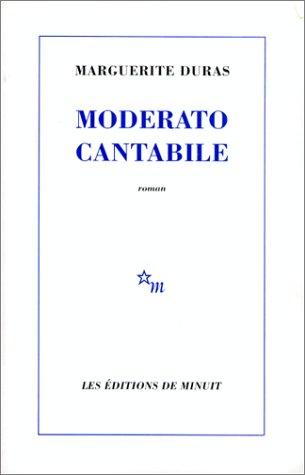
Moderato Cantabile
Marguerite Duras · 1914–1996 · France / Vietnam
Originally Moderato Cantabile (French)
Why it matters
A cry from a café, a murder of passion, and two strangers rehearsing it over wine: desire conducted entirely in subtext. Duras's nouveau-roman-adjacent breakthrough: what's omitted does all the work.
At a glance
Spare dialogue-driven prose where meaning lives almost entirely in subtext.
Deep dive
A piano lesson in a small French port town is interrupted by a scream from a nearby café, and the wealthy mother in attendance spends the rest of the novel trying to talk her way inside whatever produced it.
Written for readers who have finished the book. No plot recap, and nothing here is safe to read first.
Themes & symbolism
Duras opens on the most controlled scene imaginable, Anne Desbaresdes overseeing her son's piano lesson, its tempo marking, moderato cantabile, moderately and songfully, giving the novel its title and its ironic register, and immediately punctures it with a scream and a gunshot from the café below, where a man has just killed the woman he loved. The interruption never stops interrupting: for the rest of the book, Anne's rigidly scheduled life as a factory owner's wife keeps colliding with her compulsion to return to that café, drink wine she has no practice drinking, and ask a stranger to describe a violence she has decided must explain something about her own numbness.
Chauvin, the laborer who claims to have known the murdered woman, becomes less a source of information than a collaborator in a shared fiction: together he and Anne reconstruct and elaborate the crime across a week of conversations that grow more intimate and more clearly displaced, since what they are actually circling is their own mutual, impossible desire, coded as curiosity about people neither of them really knew. Duras's famously spare, repetitive dialogue, characters restating each other's sentences back with small variations, turns the café conversations into something closer to ritual or music than plot, extending the novel's title into its very syntax: moderate, songful, and underneath entirely about to break.
Class runs through the novel as a wall Anne can approach but not cross. Chauvin works at her husband's factory; the dead woman and her killer belonged to a world of raw appetite that Anne's bourgeois marriage has insulated her from completely, down to the ritual dinner party later in the novel where Anne, having spent the day drinking with Chauvin and skipping meals, arrives visibly undone in front of her husband's guests. Duras stages that dinner as the novel's clearest indictment of the life Anne is failing to perform correctly: not a woman collapsing, but a woman finally unable to keep pretending the performance was ever adequate to what she actually wanted.
The Nouveau Roman's Refusal to Explain
Duras strips the novel of the interior monologue and psychological exposition that a more conventional treatment of adultery and repression would supply, giving readers almost nothing but dialogue, gesture, and the recurring image of the sea beyond the café window. That refusal aligns her with the Nouveau Roman writers she was loosely associated with in the late 1950s, for whom plot and motive were suspect inheritances from a nineteenth-century novel too confident about what could be known of another person. The murdered woman is never named; the killer's exact words are never confirmed. Duras trusts the reader to sit with that absence rather than resolving it, which is precisely what makes Anne's own unexplained hunger for the story feel so exposed.
The last seal: what actually happens, and why it lands the way it does.
The ending, explained
Anne and Chauvin's final meeting at the café ends not in consummation but in its opposite: Chauvin tells her flatly that he wishes she were dead, and Anne, far from recoiling, seems almost to accept the statement as the most honest thing anyone has said to her in the novel, a violence commensurate with what she has actually been asking for all along. They part without touching, the desire that has organized a week of conversations never once physically enacted, which is the point Duras has been building toward: what Anne wanted from Chauvin was never really him, but the permission his company gave her to feel something as total as what killed the woman in the café. She returns, presumably, to her husband's dinner table and her son's piano lessons, the moderato cantabile of her scheduled life resuming exactly where it left off, except that the reader now knows what that composure is holding back.