
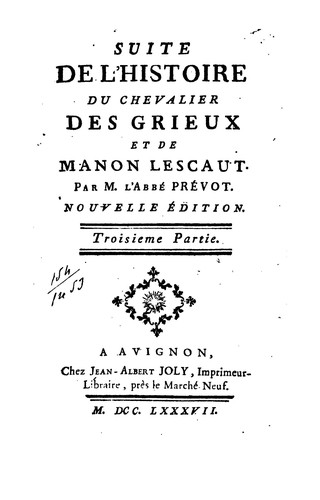
Manon Lescaut
Abbé Prévost · 1697–1763 · France
Originally Manon Lescaut (French)
Why it matters
A young nobleman ruins himself, again and again, for an amoral and irresistible woman. Its portrait of obsessive desire (helpless, self-aware, and unstoppable) made it one of the century's most influential love stories, twice turned into opera.
At a glance
Compact, urgent first-person confession with little structural complication.
Deep dive
A young nobleman narrates his own repeated ruin with total clarity about what it's costing him, and still can't stop paying it — an Enlightenment-era case study in a desire that reason never quite touches.
Written for readers who have finished the book. No plot recap, and nothing here is safe to read first.
Themes & symbolism
Des Grieux tells his own story after the fact, to the Marquis de Renoncour, fully lucid about Manon's faults and his own — and the telling itself becomes another act of seduction, this time worked on the listener rather than on Manon. That's the novel's real audacity: it hands its Enlightenment readers a narrator who diagnoses his own madness in perfectly reasonable prose and still cannot apply the diagnosis to himself, undercutting the age's confidence that reason, once consulted, would naturally govern the passions. Des Grieux's slide from seminarian to cardsharp to accomplice in violence isn't presented as moral collapse so much as a demonstration that lucidity and self-destruction can occupy the same sentence indefinitely.
Manon herself resists the clean judgment the century wanted to pass on her. Her practicality about money and comfort reads to the men around her as amorality, but the novel keeps insisting — through Des Grieux's testimony, the only lens the reader gets — that she loves him "in her own way" even while leaving him for wealthier protectors. That refusal to resolve her into either villain or victim is precisely what scandalized eighteenth-century readers and gave the book its durable, ambiguous erotic charge.
A Scandal's Long Afterlife
Prévost's novel was banned on publication and read anyway, its frame — presented as a digression within the larger Mémoires et aventures d'un homme de qualité — doing double duty as a fig leaf of respectability for material the century officially disapproved of. Its afterlife has been almost entirely operatic: both Massenet's Manon (1884) and Puccini's Manon Lescaut (1893) return to the same deathbed reconciliation as their emotional climax, evidence that the novel's ambiguity about Manon translates as readily into aria as it does into prose.
The last seal: what actually happens, and why it lands the way it does.
The ending, explained
Convicted as a woman of loose morals, Manon is deported to the Louisiana colony; Des Grieux follows and the two attempt something like an honest life there, until the governor's nephew, wanting Manon for himself, provokes Des Grieux into a duel he believes has left the man dead. The lovers flee into the wilderness to escape reprisal, and Manon, unused to such exposure and already weakened, dies in Des Grieux's arms in the desert, affirming her love for him with her last words. He buries her with his own sword and nearly dies of grief before being repatriated to France — a punishing, unambiguous payoff after a novel that refused, until this point, to punish either of them cleanly.
Where to go next
 Voltaire · 1759CandideLvl 3Fast paced
 Denis Diderot · 1796Jacques the FatalistLvl 6Slow burn
 Samuel Richardson · 1740PamelaLvl 4Slow burn
 Pierre Choderlos de Laclos · 1782Les Liaisons DangereusesLvl 5Medium pace
 Johann Wolfgang von Goethe · 1774The Sorrows of Young WertherLvl 3Medium pace
 Thomas Hardy · 1891Tess of the d'UrbervillesLvl 4Medium pace