
The Enlightenment Novel
Swift, Fielding, Voltaire: reason tests society through satire, journey, and epistolary confession.
Before the novel had settled conventions, the eighteenth century used it as a philosophical instrument. Swift sent a surgeon through increasingly monstrous societies to expose human vanity; Voltaire's Candide demolished optimism itself in under a hundred pages of catastrophe played for comedy.
In England, Fielding and Richardson fought out the century's great formal argument: comic epic against psychological confession. Fielding's Tom Jones is a sprawling, ironic picaresque; Richardson's Clarissa builds tragedy letter by letter from a single trapped consciousness. Between them they mapped most of what the novel would later become.
How to spot it on the page
- A naive traveler or ingenue marched through escalating catastrophes to test a philosophical claim
- Reason and optimism stated as doctrine, then systematically demolished by plot
- Letters piling up in real time to build a single trapped consciousness's case
- An intrusive, ironic narrator winking over the protagonist's shoulder at the reader
- Foreign or fantastical societies used as a distorting mirror held up to home
- Catastrophe and cruelty played for comic velocity rather than pathos
What it left behind
The Enlightenment novel's argument (reason tested against experience) exhausted itself once Romanticism decided feeling mattered more than doctrine. But its two formal inventions never left: Fielding's ironic comic epic runs straight through Austen and Thackeray to any wry omniscient narrator today, and Richardson's letter-built consciousness is the direct ancestor of the confessional, single-viewpoint novel autofiction now claims as new.
Defining works
For a guided order with notes, follow the reading path →

Jonathan Swift · 1726
A ship's surgeon washes up among tiny warmongers, giants, mad scientists, and rational horses: each land a mirror turned on human vanity, greed, and cruelty. The satire is so complete it survives as a children's adventure and an indictment at once.
Voltaire · 1759
A naive young man is battered by earthquake, war, and the Inquisition while his tutor keeps insisting this is the best of all possible worlds. Voltaire's demolition of philosophical optimism remains the sharpest, funniest hundred pages in the Enlightenment's arsenal.
Henry Fielding · 1749
A foundling of good heart and worse judgment stumbles across a teeming, bawdy England toward his true parentage. Fielding's comic epic, narrated by a wry, meddling author, gave the novel a formal confidence English fiction hadn't yet claimed.
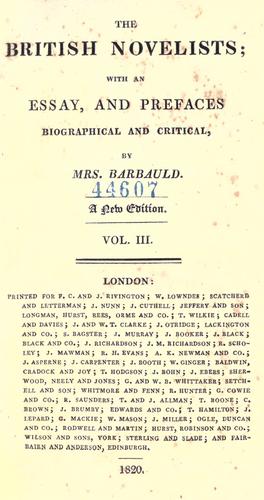
Samuel Richardson · 1748
A young woman's letters trace her family's coercion and a predator's slow-closing trap in claustrophobic, real-time detail. At a million words it is English literature's longest novel, and one of its most psychologically exact.
Authors of this movement
 1667–1745Jonathan SwiftIrelandstart with Gulliver's Travels
 1689–1761Samuel RichardsonEnglandstart with Pamela
 1694–1778VoltaireFrancestart with Candide
 1697–1763Abbé PrévostFrancestart with Manon Lescaut
 1707–1754Henry FieldingEnglandstart with Tom Jones
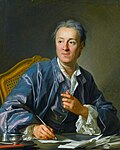 1713–1784Denis DiderotFrancestart with Jacques the Fatalist
 1741–1803Pierre Choderlos de LaclosFrancestart with Les Liaisons Dangereuses