

Paul Heyse
Germany
Polished, sunlit, classical prose: Mediterranean settings and a single luminous central image doing the work of a plot.
Heyse was the son of a Berlin classics professor, publishing precocious verse before Maximilian II of Bavaria summoned him to Munich in 1854 on a lifetime stipend to ornament the court's circle of poets. He repaid it with nearly sixty years of novellas (some hundred and eighty of them) plus plays, novels, and translations of the Italian poets he loved.
From Boccaccio's tale of a nobleman who serves his beloved his own hunting falcon, Heyse drew his 'falcon theory': every novella needs one singular, unforgettable image at its center. L'Arrabbiata (1855), written at twenty-five, remains the exemplar he never bettered.
The Nobel committee honored his 'consummate artistry, permeated with idealism' in 1910, by which time the naturalists had filed him under belle-époque china. He died in Munich in 1914, weeks before the world of his fiction did.
Their books in the atlas
- 1855
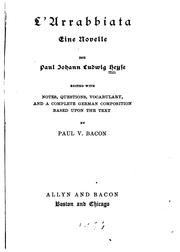 L'ArrabbiataLvl 2romance
Meanwhile, elsewhere
 1828–1910Leo TolstoyRussiaRussia & Eastern Europe · Russia
 1835–1910Mark TwainUSANorth America · USA
 1843–1916Henry JamesUSA / EnglandNorth America · USA / England
 1839–1908Machado de AssisBrazilLatin America · Brazil
 1846–1916Henryk SienkiewiczPolandRussia & Eastern Europe · Poland
 1811–1896Harriet Beecher StoweUnited StatesNorth America · United States
If you like Heyse, try
 1857–1919Karl GjellerupDenmarkkindred genres: romance · both write in German · same region & era
 1819–1898Theodor FontaneGermanykindred genres: romance · both write in German · same region & era
 1873–1954ColetteFrancekindred genres: romance · same region & era
 1832–1910Bjørnstjerne BjørnsonNorwaykindred genres: romance · same region & era
 1749–1832Johann Wolfgang von GoetheGermanykindred genres: romance · both write in German · same region & era
 1819–1890Gottfried KellerSwitzerlandboth write in German · same region & era