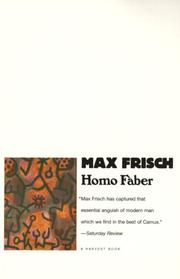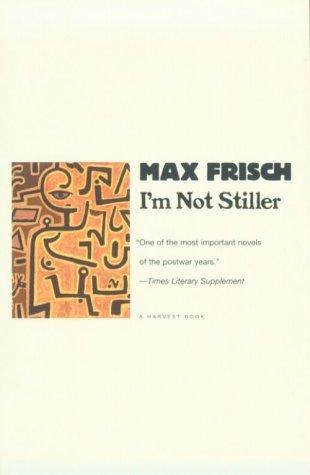
I'm Not Stiller
Max Frisch · 1911–1991 · Switzerland
Originally Stiller (German)
Why it matters
A man arrested at the Swiss border insists, against all evidence, that he is not the missing sculptor everyone recognizes him as. A restless interrogation of identity, marriage, and the stories we tell about who we are.
At a glance
Interrogation-transcript structure and shifting identity claims require close tracking.
Deep dive
A man detained at the Swiss border spends his prison notebooks insisting, at length and against all evidence, that he is not the missing sculptor everyone recognizes him as.
Written for readers who have finished the book. No plot recap, and nothing here is safe to read first.
Themes & symbolism
Held at the border under suspicion of being a missing Swiss sculptor, the narrator insists for the length of his prison notebooks that he is instead an American named James Larkin White, and Frisch structures the entire novel around a refusal that gets more implausible the harder the authorities work to disprove it. The book's epigraph, drawn from the biblical commandment against graven images, thou shalt not make unto thee any image, supplies the argument beneath the plot, that fixing another person, or oneself, into a single settled identity is itself a kind of violence, and White's increasingly elaborate American backstory is his attempt to escape being fixed at all.
Julika, the dancer he was married to as Stiller, arrives convinced she can prove his identity through sheer familiarity, and Frisch makes her certainty part of the problem rather than the solution: her fixed image of her husband as failed sculptor, disappointing partner, and finally as this stranger in custody is exactly the kind of graven image the epigraph warns against, and their reunion becomes a struggle over whose account of Stiller gets to count as real. Neither of them can fully let go of the version of Stiller they need the other to confirm, which is why proving his identity legally does almost nothing to repair what's actually broken between them.
The notebook form lets Frisch keep the narrator's unreliability structural rather than incidental, White's American tall tales, told with a confidence that outpaces their plausibility, functioning less as lies meant to deceive than as a kind of desperate self-authorship, a man trying to write himself into an identity he'd actually choose rather than accept the one Switzerland has already assigned him. Frisch, an architect by training who spent years designing buildings before turning fully to writing, gives the notebooks a builder's attention to structure even as their content keeps collapsing under cross-examination.
A Public Prosecutor's Epilogue
The novel closes with a short epilogue narrated by Rolffe, the public prosecutor and Stiller's old friend, who reports on Stiller's life after the trial from outside Stiller's own voice for the first time in the book. Handing the final word to a legal official rather than to Stiller himself underlines Frisch's point: identity, in the end, gets certified by institutions and other people's testimony rather than by the self's own insistence, exactly the outcome the narrator spent hundreds of pages of notebooks trying to prevent.
The last seal: what actually happens, and why it lands the way it does.
The ending, explained
Once the court legally confirms he is Stiller, he stops contesting it, and Frisch grants him no triumphant self-acceptance, only a quiet, diminished resignation. He and Julika retreat to a chalet in the mountains as her tuberculosis worsens, and Frisch lets their reconciliation stay incomplete even as her health declines toward her death there, Stiller present but no more capable of the intimacy she'd wanted from him than before his disappearance. He gives up sculpture entirely and takes up pottery, a humbler, more anonymous craft, and Rolffe's epilogue makes clear that Stiller never became reconciled to being himself so much as he simply stopped having the energy to keep insisting otherwise.