
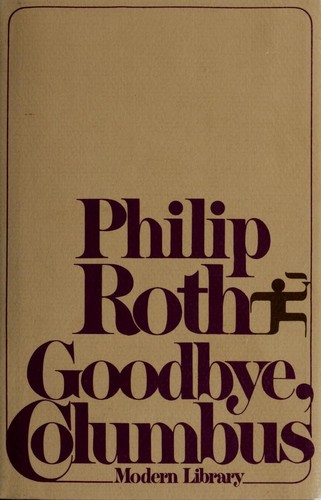
Goodbye, Columbus
Philip Roth · 1933–2018 · USA
Why it matters
A working-class Newark clerk falls for a wealthy Radcliffe girl one summer, class resentment curdling a promising romance, alongside five sharp stories of assimilating American Jewish life. Roth's National Book Award-winning debut announced a major satirist at twenty-six.
At a glance
Sharp, accessible comic prose makes this Roth's most immediately readable early work.
Deep dive
A Newark librarian falls for a wealthy Short Hills college girl one summer, and Roth measures every inch of the class gap through refrigerators, country clubs, and a diaphragm neither of them can talk about directly.
Written for readers who have finished the book. No plot recap, and nothing here is safe to read first.
Themes & symbolism
Neil Klugman lives with his aunt and uncle in working-class Newark and spends a summer courting Brenda Patimkin, whose family's sporting-goods fortune has bought a house in Short Hills stocked with two refrigerators, one holding nothing but the overflow of fruit nobody has gotten around to eating. Roth stages the romance as a tour of class distance dressed up as a summer fling, Neil cataloguing the Patimkins' effortless abundance, the country club, the wall-to-wall carpet, the casual assumption that more of everything will simply keep arriving, with a mixture of real desire and a contempt he never quite manages to resolve into either love or rejection.
The diaphragm Brenda gets fitted for, at Neil's own urging, becomes the novella's real engine, standing in for everything neither of them will say plainly about commitment, parental approval, or whose life is actually expected to bend for whose. Roth is less interested in whether the romance survives the summer than in what it exposes: an assimilation-era Jewish American ambition, the Patimkins' money scrubbed of its Newark origins, tested against actual desire the moment it has to choose between comfort and risk.
The Patimkins' Refrigerator
The second refrigerator, kept running in the Patimkins' basement purely to hold fruit of every description, peaches, grapes, cherries, plums, that nobody urgently needs, is the novella's single clearest image of wealth without material limit, and Roth returns to it more than once through Neil's eyes. Set against his aunt's careful Newark economizing, every purchase weighed and justified, the fruit that simply accumulates and sometimes spoils in the Patimkins' basement reads as abundance so complete it no longer has to notice itself, which is exactly the quality in Brenda's world Neil can't decide whether to envy or despise.
The Boy in the Library
A subplot follows a young Black boy who keeps visiting the library where Neil works, not to check anything out but simply to look, over and over, at a book of Gauguin reproductions of Tahiti. Neil quietly hides the book from the shelving system so it stays available whenever the boy returns, a small act of protection that has no real effect on Neil's own situation with Brenda but clearly mirrors it: both Neil and the boy are outsiders drawn toward a beauty and abundance they're allowed to look at but not fully possess, one guarding a library book, the other auditioning for permanent entry into Short Hills.
The last seal: what actually happens, and why it lands the way it does.
The ending, explained
Near the end of the summer, Brenda's mother finds the diaphragm hidden in her daughter's dresser drawer, and the discovery detonates the fragile arrangement Neil and Brenda had built all summer without ever naming it. Neil travels to Boston, where Brenda is starting college, to confront her about whether she'll actually stand behind their relationship against her family's disapproval, and Brenda, faced with an ultimatum she never agreed to, cannot make that choice for him. The relationship ends there, unresolved rather than dramatically severed, and Roth closes on Neil catching his own reflection in the library's glass doors back in Newark, no longer sure what, if anything, the summer was actually about beneath the fruit and the country club and the desire.
Where to go next
 Philip Roth · 1969Portnoy's ComplaintLvl 5Fast paced
 Philip Roth · 1995Sabbath's TheaterLvl 6Medium pace
 Philip Roth · 1997American PastoralLvl 6Slow burn
 Saul Bellow · 1964HerzogLvl 7Slow burn
 Joshua Cohen · 2021The Netanyahus: An Account of a Minor and Ultimately Even Negligible Episode in the History of a Very Famous FamilyLvl 6Medium pace
 Bernard Malamud · 1957The AssistantLvl 5Slow burn