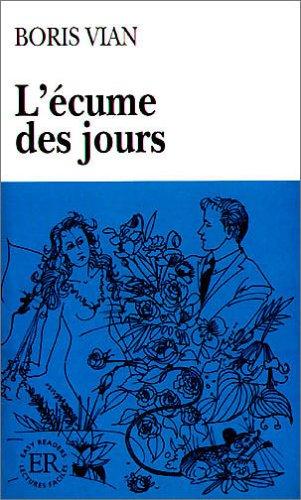
Froth on the Daydream
Boris Vian · 1920–1959 · France
Originally L'Écume des jours (French)
Why it matters
A young Parisian's carefree marriage curdles into tragedy as his wife's illness (a lily growing in her lung) slowly consumes their money and their surreal, playful world. Whimsy collapsing into heartbreak, one of French fiction's most beloved cult novels.
At a glance
Whimsical wordplay and surreal imagery complicate an otherwise simple plot.
Deep dive
A young Parisian's charmed, gadget-filled marriage starts shrinking, literally, the moment his wife falls ill, and Vian lets the couple's whimsical world darken exactly as fast as their money runs out.
Written for readers who have finished the book. No plot recap, and nothing here is safe to read first.
Themes & symbolism
Colin's Paris runs on invented machinery that makes emotion literal: the pianocktail mixes drinks keyed to the notes of whatever's being played, mice serve as a kind of household chorus, and Colin's sudden inherited wealth buys him and his new wife Chloé a life built entirely out of playful excess, an engagement party, an ice-skating rink that seats a hunting horn orchestra, a wedding overseen by a jaded church official running the ceremony on a factory line. Vian's whimsy is never just decoration; it establishes a world so committed to lightness that its coming collapse can only register as betrayal.
Chloé's illness, a water lily growing inside her lung that must be kept in check by surrounding her with fresh, increasingly expensive flowers, converts the novel's fantastical logic into a literal financial drain, and Vian tracks the couple's ruin through the apartment itself: rooms visibly narrow, windows dim, corners go dark, the physical world losing color and space in exact proportion to the money leaving Colin's account. The illness never gets a rational medical explanation, because the novel isn't interested in giving one; the lily is the marriage's economics made visible.
Chick, Colin's friend, runs a parallel ruin alongside Chloé's: his obsession with collecting every book, pipe, and personal object once touched by the philosopher Jean-Sol Partre, Vian's open parody of Jean-Paul Sartre, drains his own finances and eventually costs him his partner Alise, who reaches a breaking point Colin never does and turns to open violence against the cult of Partre worship consuming her lover.
Partre, or Sartre With the Furniture Rearranged
Vian moved in the same Saint-Germain-des-Prés circles as Sartre and Simone de Beauvoir, and Jean-Sol Partre's absurd, merchandised celebrity, lecture tours mobbed like rock concerts, an entire industry of Partre memorabilia, reads as an affectionate needling of existentialism's sudden postwar fashionability rather than a serious attack on Sartre's philosophy. The joke lands harder for how literally Chick takes it: a movement built partly on the idea of authentic individual choice produces, in Vian's telling, its most devoted follower's total financial and romantic self-destruction.
The last seal: what actually happens, and why it lands the way it does.
The ending, explained
Chloé dies once the lily and the flowers meant to hold it back have both, finally, exhausted what money Colin has left, and Vian denies the death any of the novel's earlier warmth, Colin can't even afford a proper funeral and has to bury her cheaply, alone. Alise, having already killed Partre and the staff of his publishing house in a jealous rage over Chick's obsession, is herself killed in the fire she sets. The mouse who has shared the apartment throughout, the last surviving witness to the couple's earlier happiness, chooses to die by placing its head in a hungry cat's mouth rather than go on watching Colin's collapse, the novel's last image trading whimsy for a small, deliberate suicide.